
Key Takeaways
- Choose channels based on your market and licence: Introducing brokers, affiliates, copy trading, and search can all work, but the right mix depends on where you operate.
- Track every client by source: Compare channels and partners on funded clients, active traders, and the cost of acquiring each one.
- Set your acquisition cost from trader revenue: Know what an active trader earns you before deciding how much you can afford to pay to acquire one.
- Build retention into the marketing plan: Onboarding, trader education, relevant products, and timely follow-ups can help keep funded clients trading.
- Check the rules before promoting: CFD marketing rules vary by market, and brokers can be held responsible for what affiliates and other partners publish.
- Focus on traders who stay active: Measure whether clients are still trading 90 days after their first deposit.
Table of Contents
- Why Brokers Should Target Active Traders
- Three Things to Set Up Before You Spend
- Four Channels That Bring Active Traders
- Trader Retention: How to Keep New Traders Active
- Which Channel to Start With
- Frequently Asked Questions About Forex Marketing Strategy
A forex marketing strategy is the plan a broker uses to find traders, get them to fund an account, and keep them trading. If this plan stops working after the first deposit, it just fills the client list with people who trade a few times and leave.
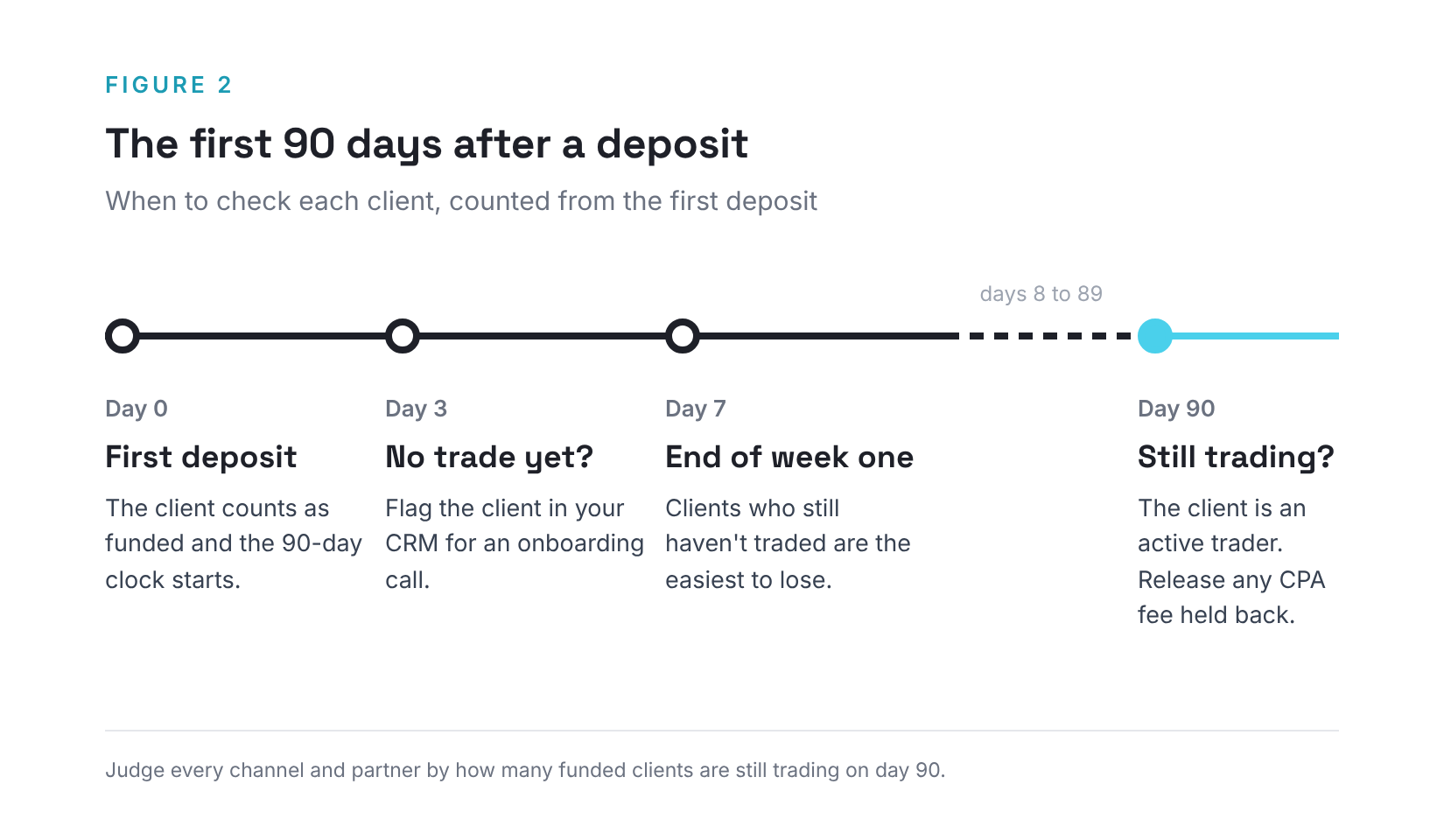
Brokers usually count a client as active after one real-money trade in a reporting period. To compare channels, we suggest a stricter test: is the client still trading 90 days after the first deposit? If yes, only that client is an active trader.
Why Brokers Should Target Active Traders
Signing up more clients does not add trading on its own, for two reasons:
Client numbers have stalled, and trading has slowed: In its Q2 2026 broker data, Finance Magnates estimated about 7.39 million active retail clients across the brokers it tracks, 0.4% fewer than in Q1. Monthly trading volume per active client fell to 45 across the 51 brokers it compared over both quarters, and the median fell 9.7%. Brokers held on to their clients, but those clients traded less.
Revenue comes from clients who stay: In its H1 2026 interim results, Plus500 earned 50% of its CFD revenue from clients of more than five years, and 20% from clients who joined within the past year. CFDs let a client trade on price moves without owning the asset, and they are the usual way retail brokers offer forex.
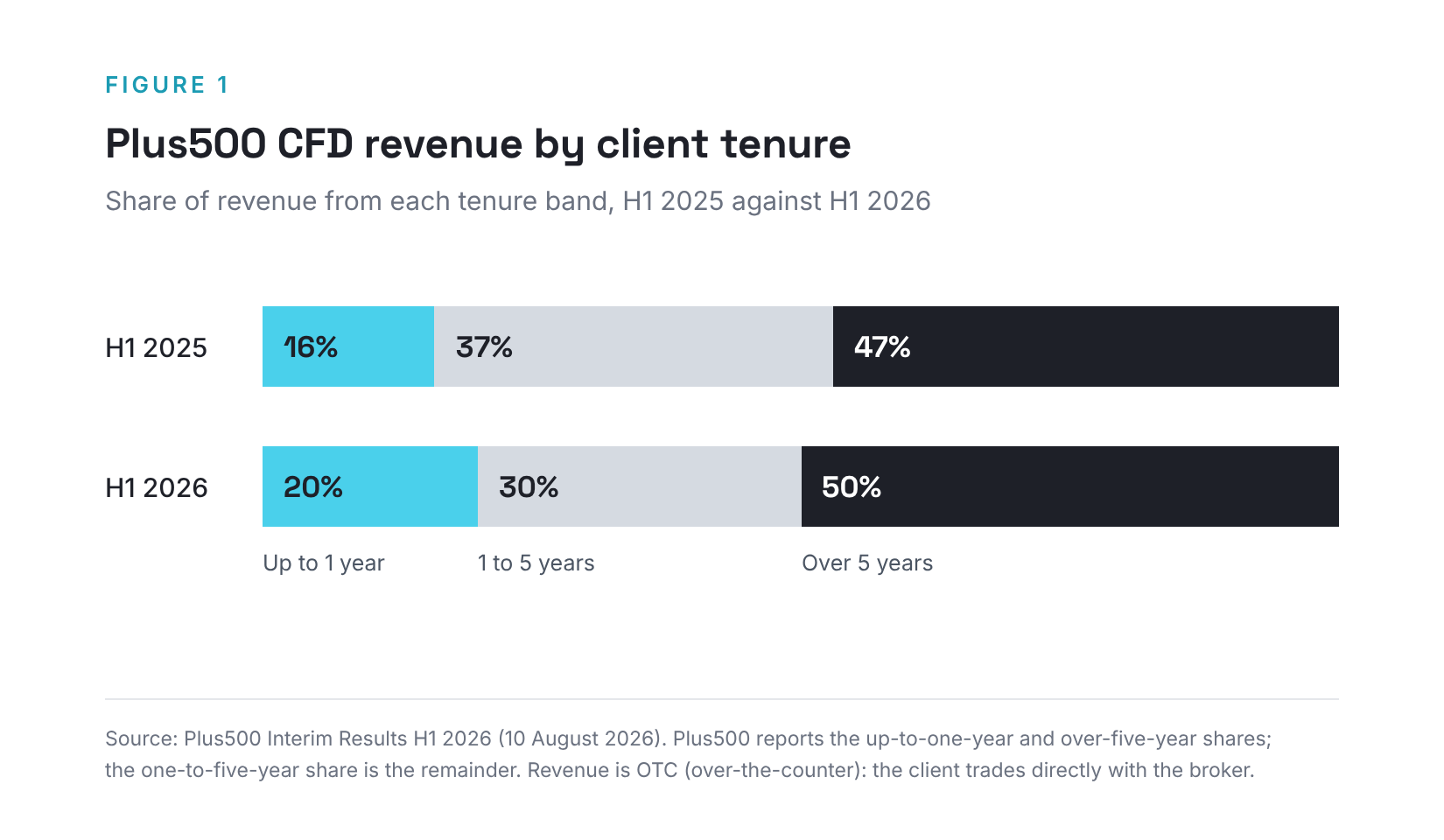
If a channel brings clients who leave within a few months, you pay the full cost of acquiring them and miss the years that bring most of the revenue.
Three Things to Set Up Before You Spend
1. Track Every Trader From Sign-Up to 90 Days
Use these four stages and record the date of each one in the CRM that holds your client records:
- Registered: The client has signed up and passed identity checks.
- Funded: The client has made a first deposit.
- First trade: The client has placed a first real-money trade.
- Active at 90 days: The client is still trading 90 days after the first deposit.
Tag every client with the source that brought them, such as a partner code or a campaign, and make the field mandatory. Without it, a partner who sends many deposits and few active traders looks like your best source.
Report these four numbers by source every month:
- Cost per funded client
- Cost per active trader
- Share of clients that reach each stage
- Days between the first deposit and the first trade
Our team has worked on broker launches in Southeast Asia, the UAE, and Latin America, and several of them needed tracking and CRM work before the partner deals could be judged on anything.
2. Set Your Forex Client Acquisition Cost Ceiling From Trader Revenue
Few brokers publish what they pay to win a client. Plus500 does: its average acquisition cost was $1,230 per new client in H1 2026, against average revenue of $2,346 per active client over the same six months. We know of no reliable public figure for smaller or offshore brokers, so set your own ceiling.
IG Group raised its marketing spend to 12% of revenue in H1 2026, from 9% a year earlier, and plans to raise it further. In its half-year results, Chief Financial Officer Clifford Abrahams gave the reason:
"...payback under six months and lifetime value comfortably ahead of acquisition cost."
Payback is the number of months it takes for a client's revenue to cover what you paid to acquire them. Use it to set your ceiling in three steps:
- Step 1: Take your average monthly revenue per active trader.
- Step 2: Multiply it by your payback period in months to get the most you can pay per active trader.
- Step 3: Multiply that by the share of funded clients who are active at 90 days to get the most you can pay per funded client.
For example, at $150 a month and a six-month payback, you can pay up to $900 per active trader. If 40% of your funded clients are active at 90 days, the ceiling per funded client is $360. A partner charging $500 per funded client pays back only if at least 56% of its clients are active at 90 days. These figures are for illustration; use your own.
3. Check CFD Marketing Compliance in Each Market
Marketing rules for CFDs are strict in the EU, UK, and Australia. Ask your compliance lead to confirm the current rules in every country you target, starting with these three areas.
- Offers are limited: In 2018, ESMA (the European Securities and Markets Authority) capped retail leverage at between 30:1 and 2:1 and banned incentives such as deposit bonuses. Brokers must also show a risk warning with the share of retail accounts that lose money. The UK's Financial Conduct Authority (FCA) and Australia's ASIC apply similar rules.
- Watch who you target: In a February 2026 statement, ESMA warned against "mass marketing campaigns, initiatives aimed at inexperienced investors, or emails and pop-ups to all clients of a firm." Messages telling people to "get started now" do not fit the narrow group of clients who opt for CFDs. Plan audiences around trading experience.
- You also answer for what your partners publish: In FG24/1, its 2024 guidance on social media promotions, the FCA says "firms remain responsible for the compliance of every promotion they make or cause to be made." This includes the affiliates, introducing brokers, and influencers you pay.
Offshore licences: A licence from a regulator outside these three markets often allows higher leverage and bonuses, but it does not let a broker market to clients there. In January 2021, ESMA said a non-EU firm that promotes itself in the EU cannot claim its EU clients approached it on their own initiative. Other countries set their own rules, so check each one you target.
Ad platforms add their own conditions for financial ads. We cover Google's and LinkedIn's rules in our fintech lead generation guide.
Four Channels That Bring Active Traders
1. Run an Introducing Broker Program in Markets Built on Relationships
An introducing broker (IB) is a person or company that refers traders to a broker and earns from their trading. Most IBs stay in touch with those traders through teaching, trade ideas, local groups, or help with deposits.
Best for: Brokers entering markets where traders follow local educators and signal groups, as in many parts of Southeast Asia, Latin America, and the Gulf.
How to run it: Pay a rebate per lot (a standard trade size) or a share of revenue, so the IB earns only when their clients trade. Put the terms in writing: what the IB may say, which materials they may use, how clients are tracked (one link or code per IB), and when you pay. Ask compliance whether the IB must be registered where you are licensed.
What to measure: For each IB, monitor funded clients, the share active at 90 days, and revenue per referred client every month.
Where it falls short: Clients often stay loyal to the IB. If a rival broker offers better terms, the IB can take them along.
2. Use Forex Affiliate Marketing for Traders Comparing Brokers
A forex affiliate is a website, publisher, or creator that sends visitors to a broker for a commission. Unlike an IB, an affiliate rarely stays in touch with the trader after the sign-up.
Best for: Brokers licensed in the EU, UK, or Australia, in markets where traders compare brokers on review sites before they choose one.
How to run it: Most affiliates are paid by CPA (cost per acquisition), a fixed fee for each client who meets agreed conditions. Define a qualifying client in the contract: verified identity, a first deposit above an agreed minimum, and at least one trade. Pay part of the fee when the client qualifies and the rest at day 90, or pair a lower CPA with a share of revenue.
Approve affiliate content before it goes live. Our team has often seen that an affiliate who passes part of the fee to the client as cashback recreates the banned deposit bonus, so prohibit it in the contract.
What to measure: Cost per active trader for each affiliate, and the share of referred clients who fail identity checks.
Where it falls short: CPA pays for qualification, so some affiliates send clients who fund once and stop. Others bid on your brand name in search ads and charge you for clients who would have found you anyway.
3. Recruit Strategy Providers Through a Copy Trading Platform
A client picks a strategy provider, an experienced trader who shares their trades, and the platform copies that provider's positions for the client. It becomes an acquisition channel when you recruit providers who bring their own followers.
Best for: Brokers with experienced traders already on their books, or with links to signal providers.
How to run it: Check each provider's record on live money, set a maximum drawdown (the largest fall from a peak you will allow), and agree on how the provider is paid, such as a share of followers' trading revenue. Show each provider's results next to the risks of copying them.
Rules to check: ESMA's 2023 supervisory briefing on copy trading says that in the EU, copying trades automatically can count as portfolio management, which needs the matching licence. Payments to providers count as inducements, the regulators' term for fees or benefits a firm pays a third party in connection with a client's business. Any benefit you state must come with a fair and prominent account of the risks.
What to measure: Funded followers per provider, the share of followers active at 90 days, and each provider's drawdown.
Where it falls short: When a provider has a losing run, many followers stop trading at the same time.
4. Capture Search Demand With Content and Paid Search
Search reaches traders at the moment they look for a broker or compare trading costs, so this form of forex lead generation needs no partner in between.
Best for: Brokers licensed in the EU, UK, or Australia that want clients without a partner fee on each one.
How to run it: Write pages that state what traders check before they open an account: spreads, fees, the licence, platforms, and deposit and withdrawal methods, including local payment options. Publish them in each market's language, and put the answer in the first lines of each page, since AI assistants tend to quote pages that state such facts plainly. A forex SEO plan covers search results and AI answers together.
What to measure: Cost per active trader by keyword group for paid search, and active traders by landing page for organic visits.
Where it falls short: Google accepts forex and CFD ads only from licensed, approved advertisers in permitted countries, and affiliates and comparison sites compete for the same searches.
Trader Retention: How to Keep New Traders Active
Retention decides how many funded clients are still trading at day 90.
Clients who fund but don't trade in the first week are the easiest to lose. A call from your onboarding team and help with a first small trade can get them going, so flag these clients in the CRM on day three.
First-time traders and experienced traders moving from another broker need different starts. Many retail CFD clients lose money, as the mandatory risk warnings show, so a first-time trader needs basic education and risk tools such as stop-loss orders, ideally after some time on a demo account. An experienced trader cares more about spreads and execution speed. Ask about experience at sign-up, and send each group its own onboarding emails.
Trading in more than one market gives a client more reasons to log in. A forex client who can see indices or shares has something to trade when currency pairs barely move.
Dormant clients come back when there is a reason to, such as a new instrument or a market event. Send each message only to the segment it fits, which also keeps you within the target-market rules.
Which Channel to Start With
With an offshore licence and a launch in Southeast Asia, Latin America, or the Gulf, start with an introducing broker program. With an EU, UK, or Australian licence, begin with affiliates and search. The table below compares the four channels on cost and timing:
| Channel | When you pay | Upfront cost | Speed to first data |
|---|---|---|---|
| Introducing broker program | As referred clients trade | Low | Weeks, once the first IBs sign |
| Forex affiliates | When a client qualifies, with part held to day 90 | Low | Weeks |
| Copy trading | As followers trade, plus platform fees | Medium | Months, until providers gain followers |
| Search and content | Before results, for media and writing | Medium to high | Weeks for paid search, months for organic |
Offshore brokers can add copy trading once they have strategy providers worth following. Brokers licensed in the EU, UK, or Australia should pay partners partly on activity at day 90. In both cases, set up tracking before you sign the first partner.
Clickeon is a forex marketing agency that works with brokers on these channels. If you want a second view on your plan, send us your target markets and your current partner terms.
Want traders who fund, not just sign up?
Book a meeting with our team to review your acquisition mix against first-deposit and retention data, not registrations.
Book a meeting →Frequently Asked Questions About Forex Marketing Strategy
What is a forex marketing strategy?
It is the plan that a broker uses to find traders, get them to fund an account, and keep them trading. A good one judges every channel by how many of its clients are still trading 90 days after their first deposit.
How do forex brokers get new clients?
Through four main channels: introducing brokers, affiliates, copy trading, and search.
What is the difference between an introducing broker and a forex affiliate?
The relationship with the trader. An introducing broker stays in touch with the traders it refers and earns as they trade. An affiliate sends visitors from its site or channel and is usually paid a fixed fee per qualifying client.
How much does it cost to acquire a forex client?
It depends on the country and the channel, and a few brokers publish the figure. To set your own ceiling, multiply what an active trader earns you each month by your payback period, then by the share of funded clients still trading 90 days after the first deposit.
Can forex brokers offer deposit bonuses?
Not to retail clients in the EU, the UK, or Australia, where CFD rules ban incentives of this kind. Some offshore regulators allow bonuses, but an offshore licence does not permit marketing to clients in these three markets. Elsewhere, the rules vary by target country.
Is copy trading worth adding for a broker?
Yes, if you can recruit strategy providers who already have followers and your licence covers the service. In the EU, automatic copying may require a portfolio management licence.