
Key Takeaways
- A fintech marketing strategy runs on six sequenced steps, from goals to measurement, and skipping this order is why most plans stall.
- Webinars and thought-leadership SEO are the cheapest fintech marketing channels in both B2B and B2C; account-based marketing costs more than what a webinar-acquired B2B customer does.
- Onboarding is where acquisition budgets leak. Seven in ten financial institutions lost their clients to slow or complex onboarding in 2025.
- Today, half of B2B software buyers first research in an AI chatbot instead of a search box, which makes AI search visibility a key measurement step.
Table of Contents
- What is a Fintech Marketing Strategy?
- What Needs to Be Checked Before You Build the Plan
- The 6-Step Fintech Marketing Strategy Framework
- What Fintech Customer Acquisition Costs in 2026
- Five Mistakes That Stall a Fintech Growth Strategy
- The Bottom Line on Fintech Marketing Strategy
- Frequently Asked Questions About Fintech Marketing Strategy
A fintech marketing strategy is the sequenced plan that turns positioning into a pipeline. It sets goals, narrows down the audience, picks the relevant channels, and defines how success is measured, before any ad goes live. Usually, teams jump straight to channels, a paid campaign here and a content calendar there, and the growth flattens.
The six-step fintech marketing plan below fixes this order. It is written for marketing leads and founders who already know the product works and need a repeatable way to put it in front of the right buyers at a cost the business can defend.
What is a Fintech Marketing Strategy?
Marketing a financial product carries a cost other than the rest of the categories. UK-authorised firms amended or withdrew 19,766 financial promotions after regulator intervention in 2024, nearly double the 10,008 logged a year earlier (FCA, 2025). This is the bar every fintech campaign has to clear before it earns a click.
A fintech marketing strategy is a documented sequence of goals, audience definition, channel selection, content investment, and measurement that a financial technology company follows to turn awareness into funded accounts. What separates it from a general marketing plan is the compliance gate. Claims about fees, security, rates, or returns have to go through reviews before they run, which changes the choice of channel, creative timelines, and related.
By the end of this guide, you will have a working document that names one pipeline goal, an ideal customer profile, a channel mix priced against real benchmarks, a content engine, and the three metrics to check monthly.
What Needs to Be Checked Before You Build the Plan
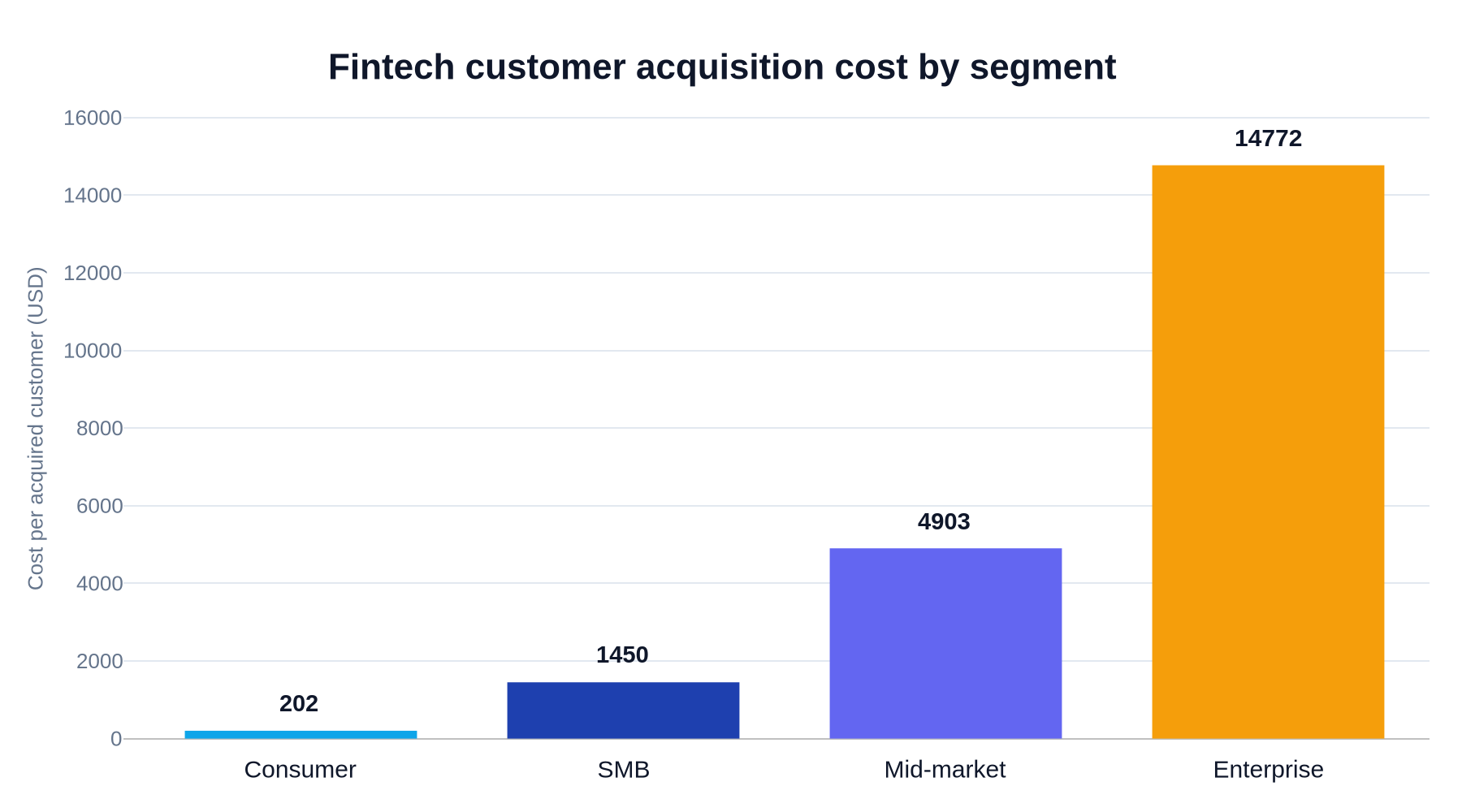
Sequencing failures are quite expensive at current prices. SMB-focused fintechs pay an average of $1,450 to acquire one customer, mid-market runs $4,903, and enterprise reaches $14,772 (First Page Sage, 2026). At these numbers, a channel plan built on guesswork burns budget that startups usually cannot spend again.
A pattern shows up repeatedly with seed-stage neobanks: The channel plan is ready first (paid social, an influencer list, a content calendar), before a qualified lead is defined. Three months later, the team has app downloads and almost no funded accounts. The channels were not the problem here, but the order was.
Three things need to be in place before building a plan:
- A tested value proposition: You should already know, from conversations or pilot users, which specific problem makes users switch providers. If that is a guess, marketing will only amplify your guesswork.
- Compliance awareness: Know which regulator or regime covers your product, whether that is lending, payments, custody, or advice, as it determines what you are allowed to claim. This must be done before writing any line of copy.
- Attribution that fires: A simple UTM-plus-CRM setup is the key. Without it, step six has no actual numbers to read.
The 6-Step Fintech Marketing Strategy Framework
Acquisition costs across financial services climbed 40 to 60 percent between 2023 and 2025, according to the First Page Sage benchmark set cited above. This inflation further strengthens the argument for sequencing.
Each of the six steps below narrows down the decision of the next one, cutting the waste before it is spent.
Step 1: Set Pipeline and Growth Goals
Pick a number that defines success for the next two quarters: qualified pipeline value, activated users, or funded accounts. Then, tie the target to a figure your finance team already recognises, and set an acceptable CAC ceiling against the segment benchmarks above before any campaign brief gets written.
Step 2: Define Your ICP and Split B2B From B2C
Write down who buys, who uses, and who approves. In embedded finance and B2B fintech marketing, these are three different people; in a consumer app, they are often the same one. A B2B profile needs firmographic detail: company size, existing stack, buying committee, whereas a B2C profile requires behavioural detail: income band, financial habits, and the trigger moment that makes the user switch. Conflating the two is the most common reason channel selection goes wrong in step three.
Step 3: Match Fintech Marketing Channels to the Segment
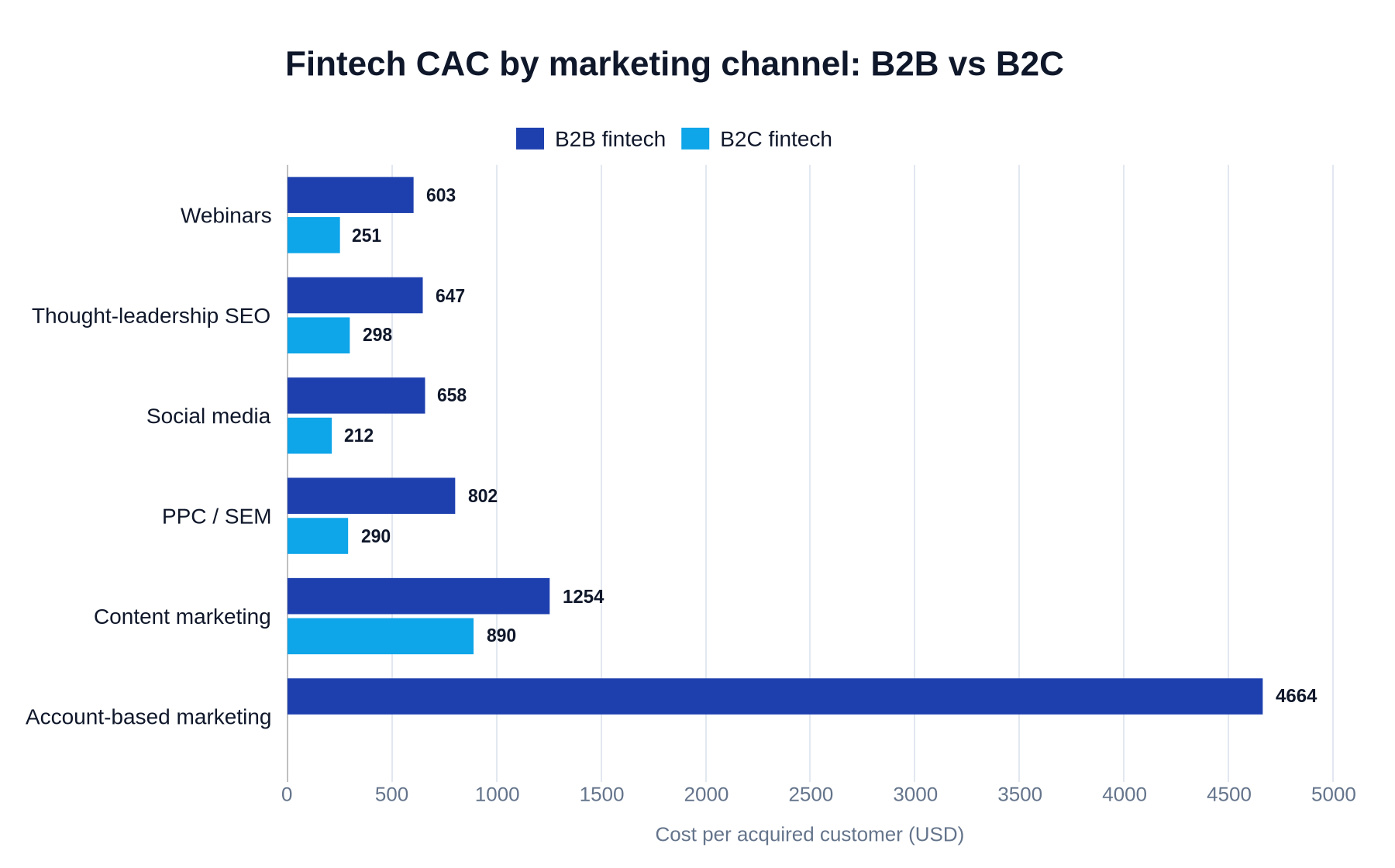
Channel mismatches are the most fixable cause of CAC overruns we see in fintech campaigns. Webinars and thought-leadership SEO post the lowest cost in both B2B ($603 and $647) and B2C ($251 and $298), while account-based marketing runs $4,664 per B2B customer and content marketing costs $1,254. This does not make ABM wasteful. Against a $100,000 enterprise contract, $4,664 is cheap. It implies choosing channels against deal size and the profile from step two, instead of choosing based on the most popular thing in your feed this quarter.
Step 4: Build the Fintech Content Engine
Hesitation in fintech is usually driven by fear rather than disinterest, which is why educational material outperforms product-first messaging in unfamiliar categories. Plain-language explainers, honest fee and risk breakdowns, and side-by-side comparisons do the work that a feature list cannot. So, you must see fintech content marketing as a standing function: a blog, a help centre, and onboarding emails that keep teaching after signup. Clickeon's fintech marketing services cover building this engine for enterprises.
Step 5: Fix Conversion and Trust Signals in the Funnel
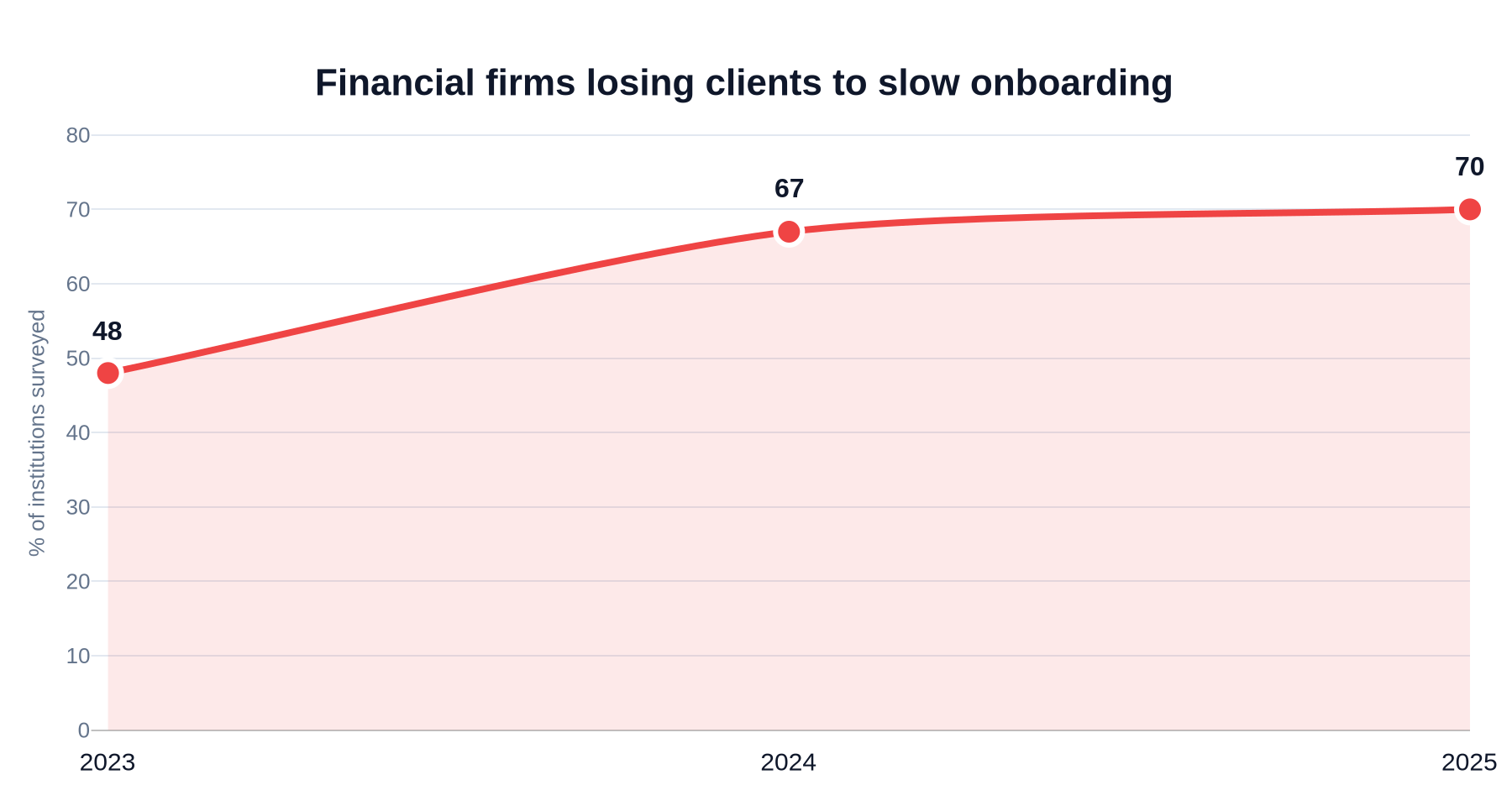
Seventy percent of financial institutions lost clients to slow or complex onboarding in 2025, up from 67 percent in 2024 and 48 percent in 2023, across a survey of 600 senior decision-makers in the UK, US and Singapore (Fenergo, 2025). No amount of top-of-funnel spend fixes a break three layers into signup.
To spot the drop, you must map the funnel: signup, identity verification, funding, and first meaningful action. For many fintechs, the verification and funding steps lose more prospects than any ad. So, you must put trust signals where the drop-off is, i.e., security certifications at verification, a transparent fee page at funding, and a reachable human at both.
"The brands that scale are the ones earning confidence through clear communication, responsible data practices, and consistent compliance. When trust is embedded into the marketing strategy from day one, growth becomes both sustainable and defensible."
— Christiana Minga, Managing Director of Brand, Power Digital, 2026
Step 6: Measure Three Numbers and Track AI Search Visibility
You must check three things every month: CAC by channel against the step-three benchmarks, pipeline velocity, and activation rate. These hold more value than ten other unimportant metrics.
51% of B2B software buyers start research with an AI chatbot, up from 29 percent eleven months earlier, and 69 percent selected a different vendor than planned based on what the chatbot said (G2, 2026). One in three bought from a vendor they hadn't heard of before that conversation.
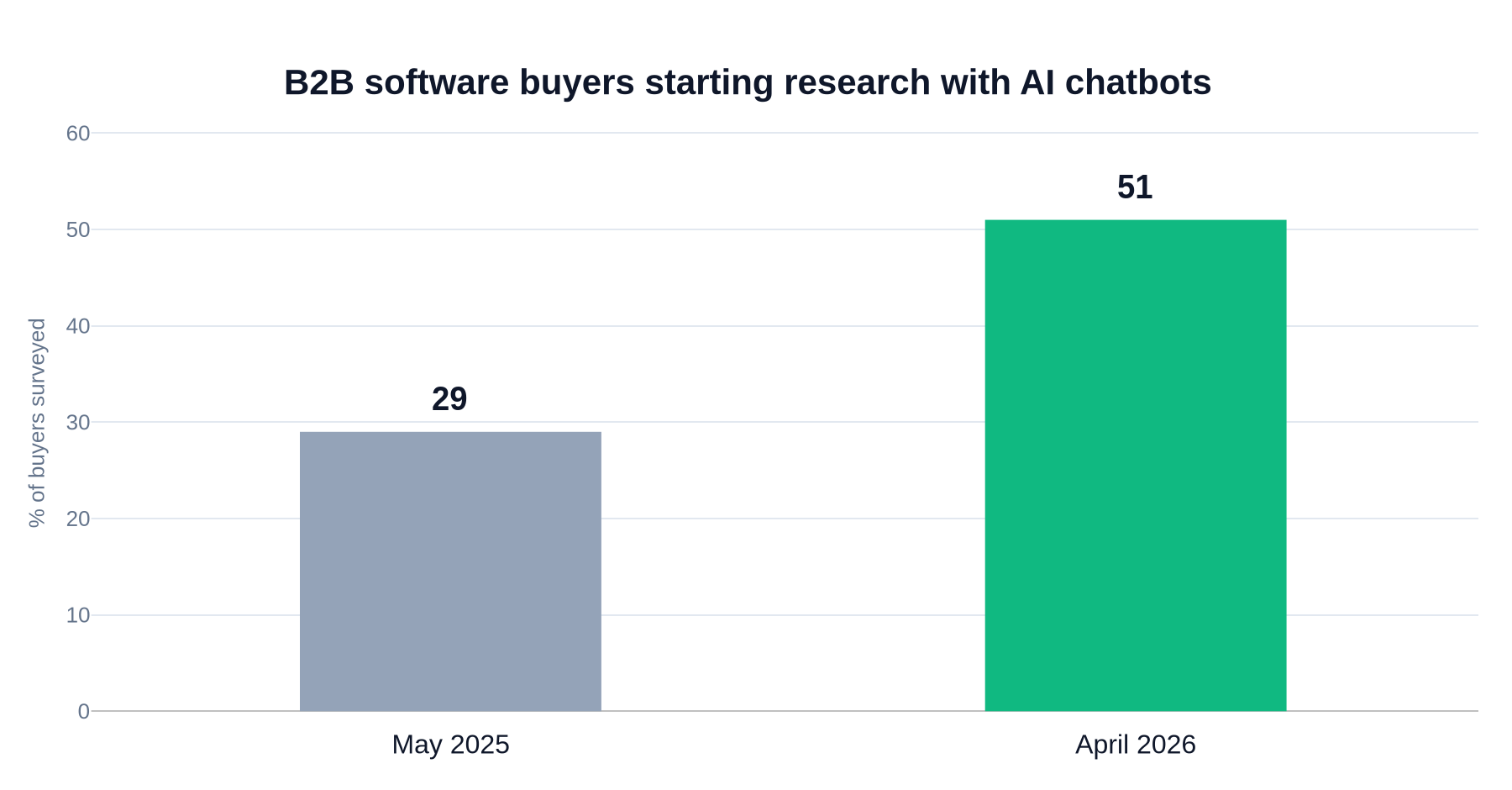
So, the practical test is whether your explainer content gets quoted when someone asks ChatGPT, Perplexity, or Google's AI a question your product solves. You should track AI search visibility the way you track rankings: pick twenty buying-intent questions, run them monthly, and record whether you are cited. Our fintech marketing articles work through the tactics that move this number.
Need a fintech marketing plan you can act on?
Book a meeting with our team to turn these six steps into a plan for your audience, channels and budget.
Book a meeting →What Fintech Customer Acquisition Costs in 2026
Every channel in step three carries a sourced price, and the spread between B2B and B2C is wider than most teams budget for. The fintech CAC benchmarks below come from First Page Sage's fintech data set, last updated in December 2025.
| Channel | B2B CAC | B2C CAC |
|---|---|---|
| Public speaking | $518 | $472 |
| Webinars | $603 | $251 |
| Thought-leadership SEO | $647 | $298 |
| Social media | $658 | $212 |
| PPC / SEM | $802 | $290 |
| Video marketing | $815 | $301 |
| Content marketing | $1,254 | $890 |
| Trade shows | $1,390 | Not reported |
| Account-based marketing | $4,664 | B2B only |
Fintech customer acquisition cost by channel, B2B versus B2C. Source: First Page Sage, updated December 2025.
Read the above as averages. A neobank's true cost runs much above the headline figure once identity checks, signup incentives, and card issuance are included. The gap between the loaded figure and the marketing-only one is wide enough to change which channels look affordable. So, you must budget against the loaded number rather than the one that looks good in a board deck. For how this plays out across actual engagements, see Clickeon's fintech case studies.
Five Mistakes That Stall a Fintech Growth Strategy
The plan above breaks in practice more often from sequencing errors than from weak tactics. A paid campaign itself isn't a mistake, but running it before step two generally is. The following five things account for most of the stalled fintech growth strategy work we are asked to rescue.
- Chasing traffic instead of qualified pipeline: Downloads and signups mean nothing if funded accounts do not move with them.
- Borrowing B2C tactics for a B2B sale, or the reverse: Gamified onboarding works for a consumer budgeting app and reads as unserious to a bank's procurement committee.
- Treating compliance as a launch blocker rather than a design input: Legal review after the creative is finished will often need you to start all over again, so do it before beginning.
- Measuring multiple things and reading none of them: A dashboard that nobody opens moves slower than three numbers someone checks on the first Monday of the month.
- Optimising acquisition while ignoring onboarding: Paying $1,450 for a customer who abandons at identity verification is the most expensive mistake on this list.
The Bottom Line on Fintech Marketing Strategy
A fintech marketing strategy works when the six steps run in order, from goals to measurement, because each step removes waste the previous one would otherwise create. If you skip the order and the budget gets spent, you just lose the ability to say which part of it worked. With acquisition costs up 40 to 60 percent since 2023 and half of buyers now starting inside an AI assistant, that clarity separates a marketing budget that compounds from one that resets every quarter. If you would rather have a team build and run this plan than build it alone, Clickeon's fintech marketing team takes on that work.
Frequently Asked Questions About Fintech Marketing Strategy
What makes a fintech marketing strategy different from a general marketing strategy?
Every claim in fintech marketing about fees, security, rates, or returns has to go through regulatory review before it runs. This constraint reshapes channel choice, content tone, approval timelines, and how fast a campaign moves from brief to live. UK regulators forced changes to nearly 20,000 financial promotions in 2024 alone, which is the practical cost of getting it wrong.
How much should a fintech company budget for customer acquisition in 2026?
You need to budget against your segment rather than an industry average. As per First Page Sage's 2026 benchmarks, consumer fintech averages around $202 per customer, SMB $1,450, enterprise $14,772, and mid-market $4,903. Accordingly, add your own verification, incentive, and card-issuance costs to reach a fully loaded figure, and set the ceiling from that rather than from the marketing-only number.
Which marketing channels have the lowest CAC for fintech companies?
Webinars and thought-leadership SEO are cheapest in both directions: $603 and $647 in B2B, $251 and $298 in B2C. Social media is the lowest B2C channel at $212. On the other hand, account-based marketing is the most expensive at $4,664 per B2B customer, but still efficient against six-figure enterprise contracts and wasteful against small ones.
Should B2B and B2C fintech companies use the same marketing channels?
No. B2B buyers respond to webinars and account-based outreach because a buying committee has to be convinced together, while B2C users respond to social content built around one behavioural trigger. The cost data makes the split concrete: social media costs a B2B fintech $658 per customer and a B2C fintech $212 for the same channel.
How long does it take to see results from a new fintech marketing strategy?
It depends on the mix chosen in step three. Paid channels can show pipeline movement in four to eight weeks because spend converts almost directly into impressions and clicks. Organic channels, meaning SEO, educational content, and thought leadership, usually need two to three quarters to contribute meaningful qualified pipeline, since they depend on rankings and accumulated trust.
Do I need a compliance review before publishing fintech marketing content?
Yes, and earlier than teams usually schedule it. You must take compliance as a design input during the first step rather than the final check before publishing. Make sure to loop in compliance counsel for your specific regulatory footprint before any claim about rates, fees, security, or returns goes live.
How do I make my fintech content appear in AI search results?
For this, you must write self-contained answers. AI assistants quote passages that stand alone, so open each section with a direct answer, attach a dated source to every statistic, and structure content around the questions buyers ask. Then measure it: run twenty buying-intent prompts monthly and record whether you are cited. Considering 51 percent of B2B buyers start their research in a chatbot, being absent from those answers removes you from the shortlist before a salesperson is involved.