
Key Takeaways
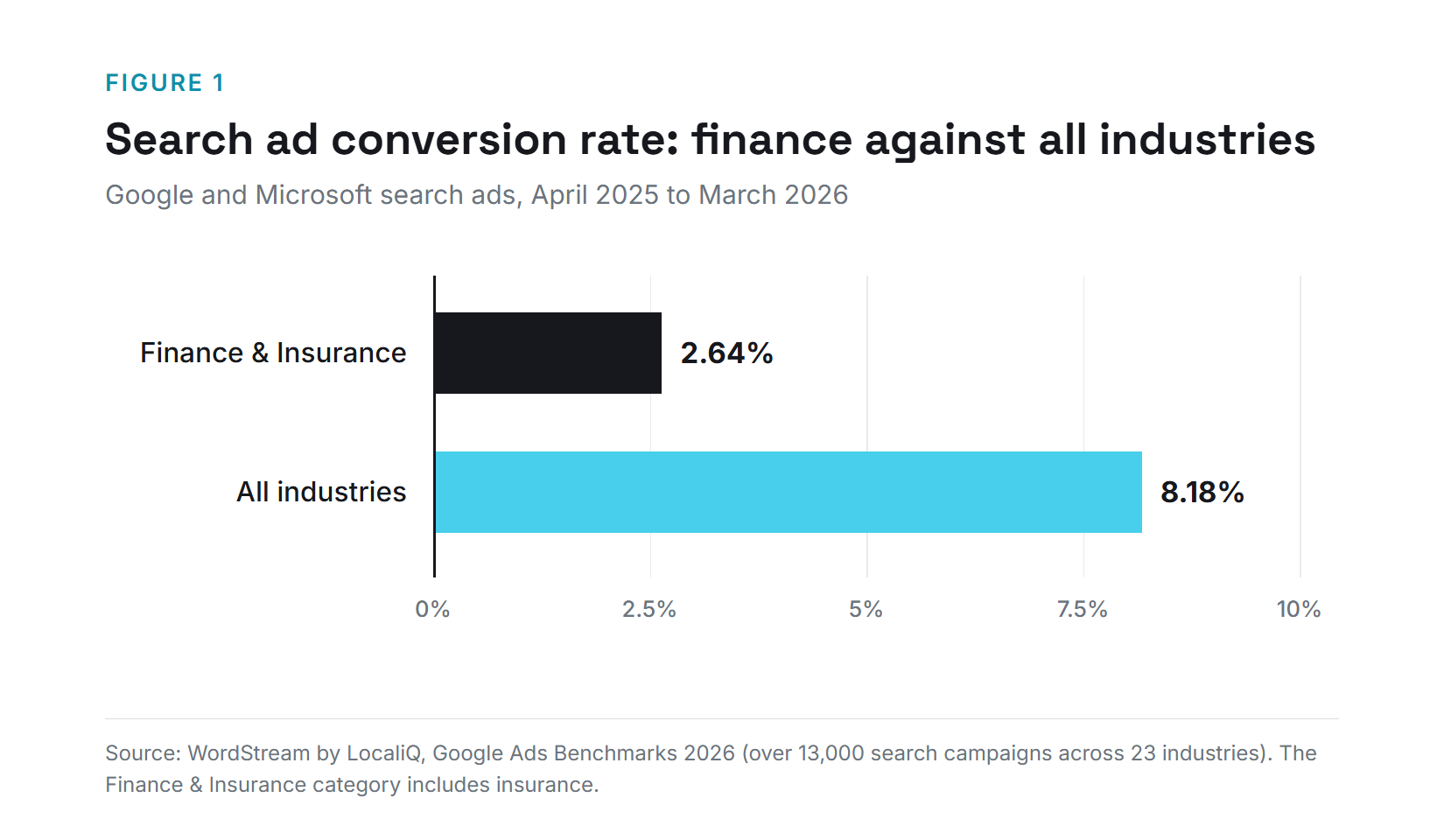
- Finance has a low average ad conversion rate: WordStream's benchmark of Google and Microsoft Ads campaigns puts Finance & Insurance at a 2.64% conversion rate. This is the lowest of the 23 industries it covers.
- Advertising comes with platform-specific restrictions: Google allows CFD and forex ads only from licensed providers with an approved account in approved countries. LinkedIn restricts financial ads and prohibits affiliate advertising.
- Track leads until they become customers: Follow each lead to a funded account or a signed contract.
- Begin with two channels: Test one paid channel and one organic channel, then add email, partners, or events once your tracking starts working.

Table of Contents
- What Makes Fintech Lead Generation Harder
- Three Things to Set Up Before You Spend
- The Six Tactics of Fintech Lead Generation
- Which Tactic to Start With
- What to Measure
- Frequently Asked Questions About Fintech Lead Generation
Fintech lead generation is the process of finding people or companies that may use a financial product and starting a conversation with them. This guide covers six tactics for 2026: Google Search ads, organic search and content, LinkedIn ads, email, partner referrals, and events and PR. For each one, you will understand how it works, how to run it, what to measure, to whom it suits, and where it falls short.
In fintech, there are two main types of leads. Consumer leads are traders and investors who may open an account. Business leads are companies, such as brokers choosing a payment provider or a platform choosing a technology vendor.
What Makes Fintech Lead Generation Harder
Fintech lead generation is more difficult than most other categories, because of the following three reasons:
Conversion is lower: At 2.64%, Finance & Insurance lies well below the 8.18% all-industry average in WordStream's 2026 Google Ads benchmarks. Judge your own cost per lead against your history and other fintech campaigns, because the all-industry average may not describe your specific category.
Advertising is restricted: Platform criteria decide who can advertise financial products, and the rules differ by country and by product. The next section covers the main ones.
Business buyers decide early: 6sense 2025 Buyer Experience Report states that 94% of B2B buying groups select their preferred vendors before first contact.
"Buyers are choosing a preliminary winner much earlier than they have in the past," said Kerry Cunningham, Head of Research & Thought Leadership at 6sense.
Three Things to Set Up Before You Spend
1. Check the Advertising and Promotion Rules for Each Market
Ask your compliance lead to confirm the latest rules for every country you plan to target.
- Google: Under Google's financial products and services policy, CFDs, financial spread betting, and rolling spot forex may only be advertised by a licensed provider or aggregator. The account must be approved by Google, and the ads may run only in countries Google allows. Check that each country you target is allowed when you apply. Ads for binary options are not allowed, and crypto has its own Google policy.
- LinkedIn: LinkedIn's advertising policies restrict ads for financial products and services. Ads aimed at UK audiences may come only from advertisers authorised by the Financial Conduct Authority (FCA), the UK regulator. It also prohibits affiliate advertising.
- CFD risk warnings: ESMA's 2018 measures on CFDs require a standard risk warning that shows the percentage of retail accounts that lose money with that provider. They also stop providers from offering incentives. ESMA is the EU's securities regulator, and the FCA applies similar rules in the UK. Confirm the current wording for each regulator you work under.
2. Track Every Lead to an Outcome
Use these three stages and record the relevant date in your CRM:
- Lead: Someone has filled in a form, opened an account, or asked for a call.
- Qualified lead: Your sales or onboarding team marks the lead as the right fit.
- Funded account or signed contract: The lead has become a customer.
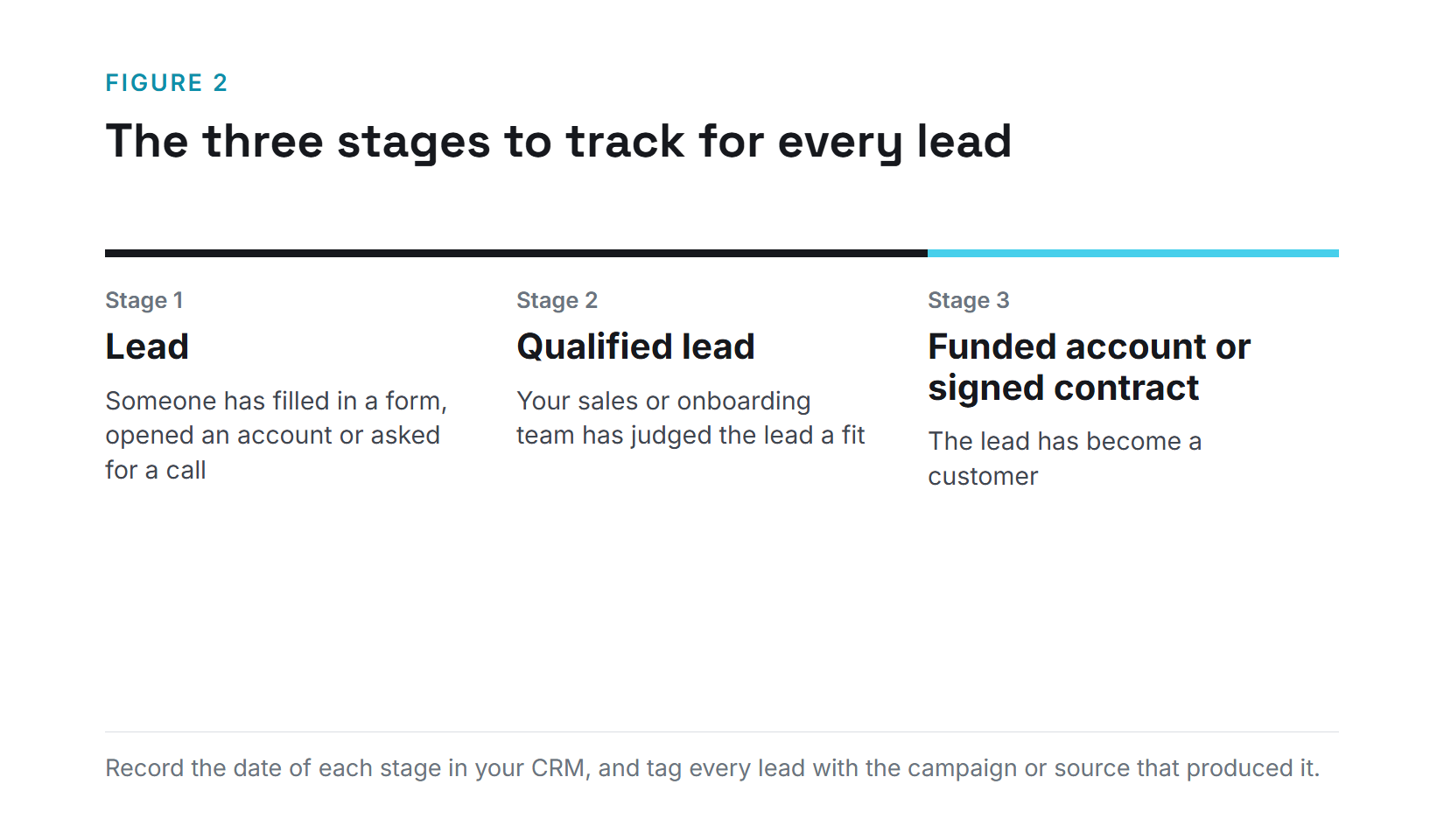
Add a hidden field to every form that records the campaign or source, and make it mandatory in the CRM. Without it, budget drifts towards the channel that produces the cheapest form fills.
Our team has worked on broker launches in Southeast Asia, the UAE, and Latin America. Several of them needed tracking or automation work alongside the media. This is why we suggest you fix tracking before you choose a tactic.
3. Give Every Lead an Owner and a Reply Deadline
Designate a person who answers each lead and the time by which they must do it. Set the deadline with your sales team, and report any lead that misses it.
The Six Tactics of Fintech Lead Generation
1. Google Search Ads for People Already Looking
Best for: Consumer leads and business leads. Search ads show your offer to people who are searching for a product, a provider, or an answer. They give the fastest read on whether your offer draws interest.
How to run it: Group keywords by intent, for example, product terms, comparison terms, and problem terms. Give each group its own budget, so you can see which one produces qualified leads. Your landing page should clearly show the disclosures required by Google and the regulator of each target market, including relevant licence, fee, and risk information. If you plan to run Google Ads for forex or CFDs, confirm that you are eligible and approved before you build the campaign.
What to measure: Cost per qualified lead and cost per funded account, by keyword group. Use budget on the groups that produce them.
Where it falls short: Eligibility varies by country. A low conversion rate also means you need enough clicks in each group to analyse and interpret the numbers.
2. Organic Search and Content for Buyers Doing Their Own Research
Best for: Both lead types, on a slower timeline. Content answers the questions people ask before they speak to anyone. This includes questions put to AI assistants. The 6sense report found that 94% of B2B buyers used large language models, mostly to summarise reviews or analyse data, and no one can control whether an assistant cites a page. A page that states fees, licences, supported markets, and product limits plainly is most likely to get quoted.
How to run it: Collect the ten questions your sales and support teams hear most. Write one page for each, with the answer in the first paragraph, a named author, the date it was last updated, and the regulatory details that a reader would check. Add comparison pages only where you can state the basis of the comparison. Add a glossary for terms your buyers search. A fintech SEO plan covers both search results and AI answers.
What to measure: Add a "How did you hear about us?" field to forms and ask the same question on the first call. Count the enquiries that name a page. See rankings and visits from AI assistants as secondary signals.
Where it falls short: Results take months, and a ranking or a citation is not guaranteed.
3. LinkedIn Ads for Named Roles at Target Companies
Best for: Business leads. LinkedIn lets you show an ad to chosen job functions at companies on your uploaded list. This suits fintech vendors selling to brokers, exchanges, and platforms.
How to run it: Check the rules first, including the FCA requirement for UK audiences. Upload your target company list and select the job functions on the buying side, for example payments, compliance, finance and technology. Offer them something useful behind a short form, such as a guide to licence requirements by market. Run one offer at a time, so the CRM shows which one worked. LinkedIn's help pages say an ad needs an audience of at least 300 members, so a very short list may not run.
What to measure: Qualified leads at target accounts after the first full cycle of spend.
Where it falls short: The restrictions on LinkedIn ads for financial services, and the cost of reaching a small audience.
4. Email for Outreach and Lead Nurture
Best for: Business outreach and follow-up with consumer sign-ups who have agreed to hear from you. Fintech email marketing works well when the email arrives for a reason. For business outreach, a public event can supply the reason: a new licence in a country, a market launch, a senior hire, or a run of public complaints about failed deposits. A nurture sequence, which is a short series of follow-up emails, suits sign-ups who have not yet funded an account.
Rules to check: In the UK, the Information Commissioner's Office (ICO) says the PECR rule on marketing by email does not apply to corporate subscribers such as limited companies. It does apply to sole traders and some partnerships. PECR is the UK's set of rules on electronic marketing. Data protection law still applies when you use a named person's details, and recipients can object. EU countries set their own rules, so check each market that you email, and respect the opt-outs.
How to run it: Write two or three sentences. State why you are writing, make one offer, and ask one question. Set up SPF, DKIM, and DMARC, the settings that show a mailbox provider your domain sent the message. Tag each sequence with the event that triggered it.
What to measure: Positive replies and meetings booked, by trigger type. A reply that says "not interested" is not a lead.
Where it falls short: Poor sender reputation delivers mail to spam, and a purchased list usually lacks the timing that a trigger provides you.
5. Partner Referrals and Introducing Brokers
Best for: Brokers working with introducing brokers and affiliates, and fintech vendors working with consultants, platform providers, and compliance firms. A partner who already serves your buyers can introduce you when the need arises.
How to run it: Agree on written terms covering what the partner may say, how leads are tracked (a link or code per partner), and how and when you pay. Ask compliance who may promote your products in each market and what you must approve or record. Give each partner a one-page brief and a named contact. Add a partner field to the CRM.
What to measure: For each partner, monitor introductions, qualified leads, and funded accounts or signed contracts each month. Review partners whose leads qualify at a lower rate than your average.
Where it falls short: You have less control over what a partner says, and in a regulated market it may become your responsibility.
6. Events, Webinars and PR
Best for: Business leads and brand recognition with all buyers. Business buyers form shortlists before contacting a vendor. Meeting them at events, in webinars, and in the trade press can put you on their list before the search starts.
How to run it: Pick events your target companies attend, and book meetings in advance. Follow up within the deadline you set for every lead. Host a webinar on a question your buyers already ask. Place articles and commentary in outlets those buyers read, on your own or with a PR and distribution partner.
What to measure: Meetings booked, target accounts met, and how many of them became qualified leads. Tag every lead with the event or placement that produced it.
Where it falls short: Cost is high, and attribution is weak, so rely on the source tag and the first-call question.
Which Tactic to Start With
The table below compares tactics as per different categories:
| Tactic | Best for | Speed to first data | Main limitation |
|---|---|---|---|
| Google Search ads | Consumer and business | Fast | Eligibility by country |
| Organic search and content | Consumer and business | Slow | No guaranteed ranking or citation |
| LinkedIn ads | Business | Fast | Financial ad restrictions |
| Business, nurture | Fast | Consent rules, sender reputation | |
| Partner referrals | Both | Slow | Less control over messaging |
| Events, webinars and PR | Business, brand | Slow | Cost and attribution |
If you sell to traders and hold the licences Google requires, begin with search ads and content. But if you sell to named companies, begin with LinkedIn ads or triggered email, and add one partner. In both cases, you must fix tracking before you spend.
We run these tactics for forex brokers and crypto firms. If you want a second view on your plan, send us your target markets and the tactics you want to test.
Want a lead generation plan that fits your sales cycle?
Book a meeting with our team to pick the tactics that match your ICP, compliance limits and timeline.
Book a meeting →What to Measure
Report four numbers by source every month:
- Cost per qualified lead
- Cost per funded account or signed contract
- Share of leads that reach each stage
- Time to first reply
A source that produces many leads and no customers costs you sales time.
Frequently Asked Questions About Fintech Lead Generation
What is fintech lead generation?
It is the process of finding people or companies that may use a financial product and initiating a sales conversation with them. Fintech companies use search ads, content, LinkedIn ads, email, partner referrals, and events to do it, within the advertising and promotion rules of each market.
Can a broker run Google ads for forex or CFDs?
Only in some cases. Google allows ads for CFDs, financial spread betting, and rolling spot forex from licensed providers or aggregators with an approved account, in the permitted countries. Ads for binary options are not allowed.
Can fintech companies advertise on LinkedIn?
Yes, but with limits. LinkedIn restricts ads for financial products and services. Ads for UK audiences may come only from FCA-authorised advertisers, and affiliate advertising is prohibited. Check LinkedIn's current policy before you plan a campaign.
Do you need consent to send marketing emails to businesses in the UK?
Not for limited companies. The PECR rule on marketing by email does not apply to corporate subscribers such as limited companies. It does apply to sole traders and some partnerships. Data protection law still applies to a named person's details, so honour objections. Other countries set their own rules.
What is a good conversion rate for fintech search ads?
In WordStream's benchmark for April 2025 to March 2026, Finance & Insurance averaged 2.64% across Google and Microsoft Ads, against 8.18% for all industries. The category includes insurance, so use it as a rough guide. It's better to compare against your own history.
How long does fintech lead generation take to show results?
Paid tactics return data soon after ads are approved and running. Organic content and partner referrals take longer. We know of no published benchmark for fintech, so set your own baseline in the first months.