
Key Takeaways
- Your published data now outweighs press coverage. 86% of AI citations come from sources brands already control, mainly websites and directory listings, measured across 6.8 million citations in ChatGPT, Gemini, and Perplexity (Yext, 2025).
- Trust in financial services reached 63% in 2026, climbing 10 points across five years. Banks score 65%, while Crypto sits at 41% (Edelman Trust Barometer, 2026).
- Security is the budget line. One breach costs a financial firm $6.08 million on average, 22% above the cross-industry mean (IBM, 2024).
- All twelve shifts imply one thing: Winning a customer costs more every year, so spending is moving toward channels that keep working after the money stops.
Table of Contents
- Budget moves from paid to owned content
- Retention gets its own budget line
- AI becomes the operating layer
- AI search becomes the gatekeeper
- First-party data becomes non-negotiable
- Trust moves into the marketing
- Founder-led content pushes back against AI-written feeds
- Community-led growth beats the paid one on cost
- Embedded finance shifts you from direct to partner-led
- Niche creators replace celebrity endorsers
- Short-form video becomes an acquisition channel
- App store optimisation matures into its own discipline
Most lists of fintech marketing trends hand you 10-20 unrelated problems. These twelve trace back to one: winning a customer costs more today than it did three years ago, while budgets stayed flat.
We work with fintech and forex brands on this point, so these twelve came out of real client planning rather than a conference deck. Each one ends with a concrete next step.
The economics behind every other shift
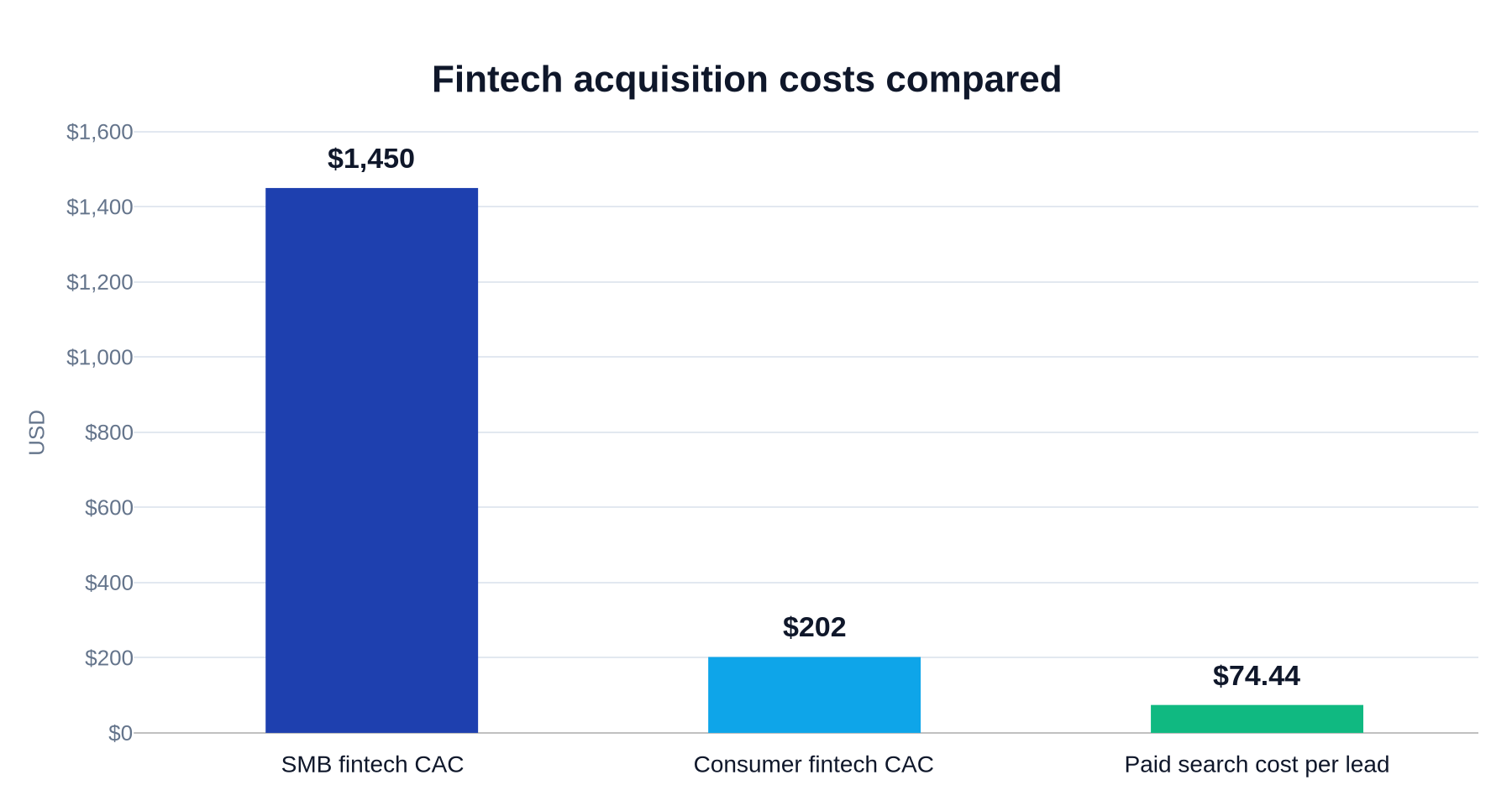
Two figures frame everything else in 2026. Search advertising in finance and insurance now costs $74.44 per lead, at $3.39 per click and a 2.64% conversion rate, well under the 8.18% cross-industry average (WordStream, 2026). Meanwhile, an SMB fintech pays around $1,450 to win each customer, versus $202 in consumer segments (First Page Sage, 2025).
Both measure a sign-up, not any funded, trading, or transacting account. Actual costs are higher, since most applicants abandon onboarding before they finish. Signicat found 68% of European consumers walked away from one during the year 2022, worse than 63% in 2020, quitting after 18 minutes and 53 seconds on average (Signicat, 2022).
Below is the full list, sorted into four groups by the pressure behind each entry.
| # | Shift | Group | First Impact on |
|---|---|---|---|
| 1 | Budget moves from paid into owned content | Economics | All fintech |
| 2 | Retention gets its own budget line | Economics | All fintech |
| 3 | AI becomes the operating layer | AI discovery | All fintech |
| 4 | AI search becomes the gatekeeper | AI discovery | B2B |
| 5 | First-party data becomes non-negotiable | AI discovery | All fintech |
| 6 | Trust moves into the marketing itself | Trust | All fintech |
| 7 | Founder-led content beats AI-written feeds | Trust | B2B |
| 8 | Community-led growth beats paid on cost | Distribution | B2C, crypto |
| 9 | Embedded finance turns growth partner-led | Distribution | B2B |
| 10 | Niche creators replace celebrity endorsers | Distribution | B2C |
| 11 | Short-form video becomes acquisition | Distribution | B2C |
| 12 | App store optimisation becomes a discipline | Distribution | B2C |
1. Budget moves from paid to owned content
Advertising still remains the quickest route to testing an unfamiliar segment, but its position in the plan has changed. Earlier, ads used to open a campaign, and today they usually scale whatever earned content has already proved.
The logic is simple: Bought reach falls to zero once the funding stops. On the other hand, a ranking guide, a Discord server, or a subscriber list goes on delivering.
Do this: Calculate cost per lead separately for search, social, email, and referral before renewing next quarter's media spend. Send money where organic wins, and let advertising amplify proven pages.
2. Retention gets its own budget line
Keeping customers used to belong to product or support, while nearly all marketing money chased fresh sign-ups. This divide is closing in 2026. Growth teams now fund lifecycle email, onboarding nudges, and loyalty mechanics with the rigour they once reserved for advertising.
Email remains the cheapest entry point. It puts the return at around $36 for every $1 spent (Litmus), a ratio that no advertising channel in finance approaches.
Start here: If retaining customers has no line item or separate scorecard, it is under-funded against what it returns. So, repair the split before touching tactics.
AI decides who gets shortlisted
This ranks as the biggest of all fintech marketing trends for 2026, and in my experience, also the least understood. Assistants like ChatGPT filter vendors before any human types a query.
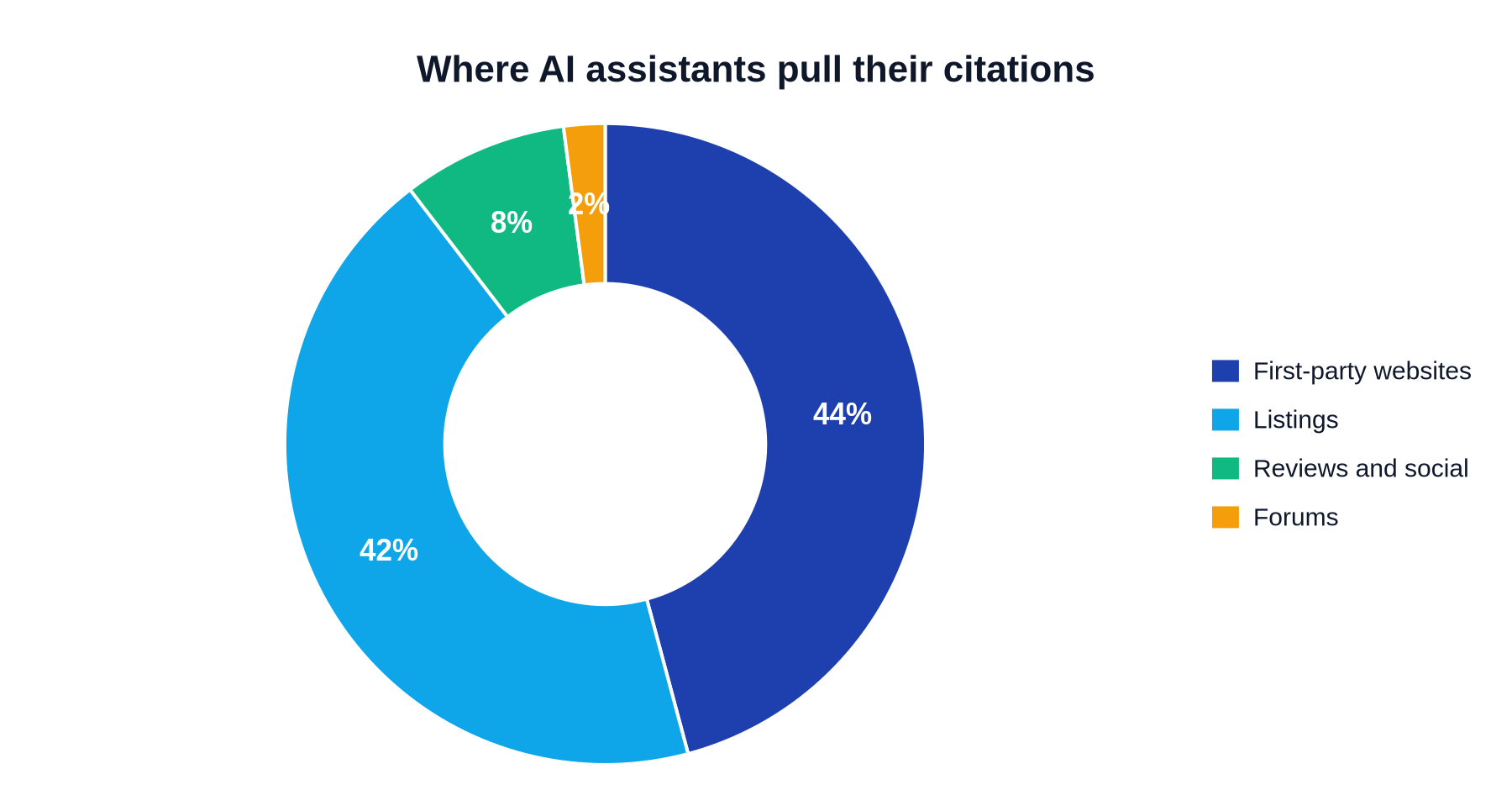
Yext examined 6.8 million machine citations drawn from 1.6 million queries put to ChatGPT, Gemini and Perplexity between July and August 2025. It found 86% of citations came from sources brands already control: 44% from first-party websites, 42% from listings, 8% from reviews and social, and 2% from forums (Yext, 2025).
In other words, your site plus your directory entries account for 86 cents in every dollar of machine visibility. So, journalists, reviewers, and forum threads barely register.
3. AI becomes the operating layer
Nearly every fintech team has run a pilot, and a few rebuilt a workflow around it. This gap explains why some report a modest bump while others compound gains quarter after quarter.
The teams we see getting real value rebuilt lead scoring, email sequencing, and creative testing so the model touches every campaign instead of just one test.
Do this: Pick one workflow and put AI in the loop for all of it. Lead scoring and subject-line testing are the easiest places to start with.
4. AI search becomes the gatekeeper
Jessica Cates of Yext sums up what this changes: "AI responds to corroboration, not persuasion." Her point is that claims have to be checked out consistently everywhere a model can look. If they do not match, the model sees the brand as unverified and moves away.
"In 2026, being considered will require being structurally legible to machines."
- Jessica Cates, Yext (Yext, February 2026)
This is a data hygiene problem: Mismatched addresses, an outdated leadership bio, a disclosure that states one thing on your site and another in a directory. Now, these are the reasons the model skips your brand.
Start here: Audit where your brand name, credentials, and claims appear across the web, and make sure they match. Start with your own site and listings, because that is where 86% of the citations are fetched from.
Is your brand showing up in AI answers?
Book a meeting with our team to audit how ChatGPT, Gemini and Perplexity see your brand, and what to fix first.
Book a meeting →5. First-party data becomes non-negotiable
Third-party data keeps shrinking, and AI tools now lie between you and the customer in more journeys. A fintech without a clean first-party pipeline is losing the ability to personalise at all.
There is a trust factor too: As AI tools remember more about someone's finances across sessions, the fintechs that show a clear data policy earn the right to personalise. The ones that cannot are seen as risky instead of convenient.
Do this: List what customer data you own outright against what you rent from ad platforms. Anything built on rented data gets weaker every time a platform modifies its rules.
Trust has turned into an acquisition channel
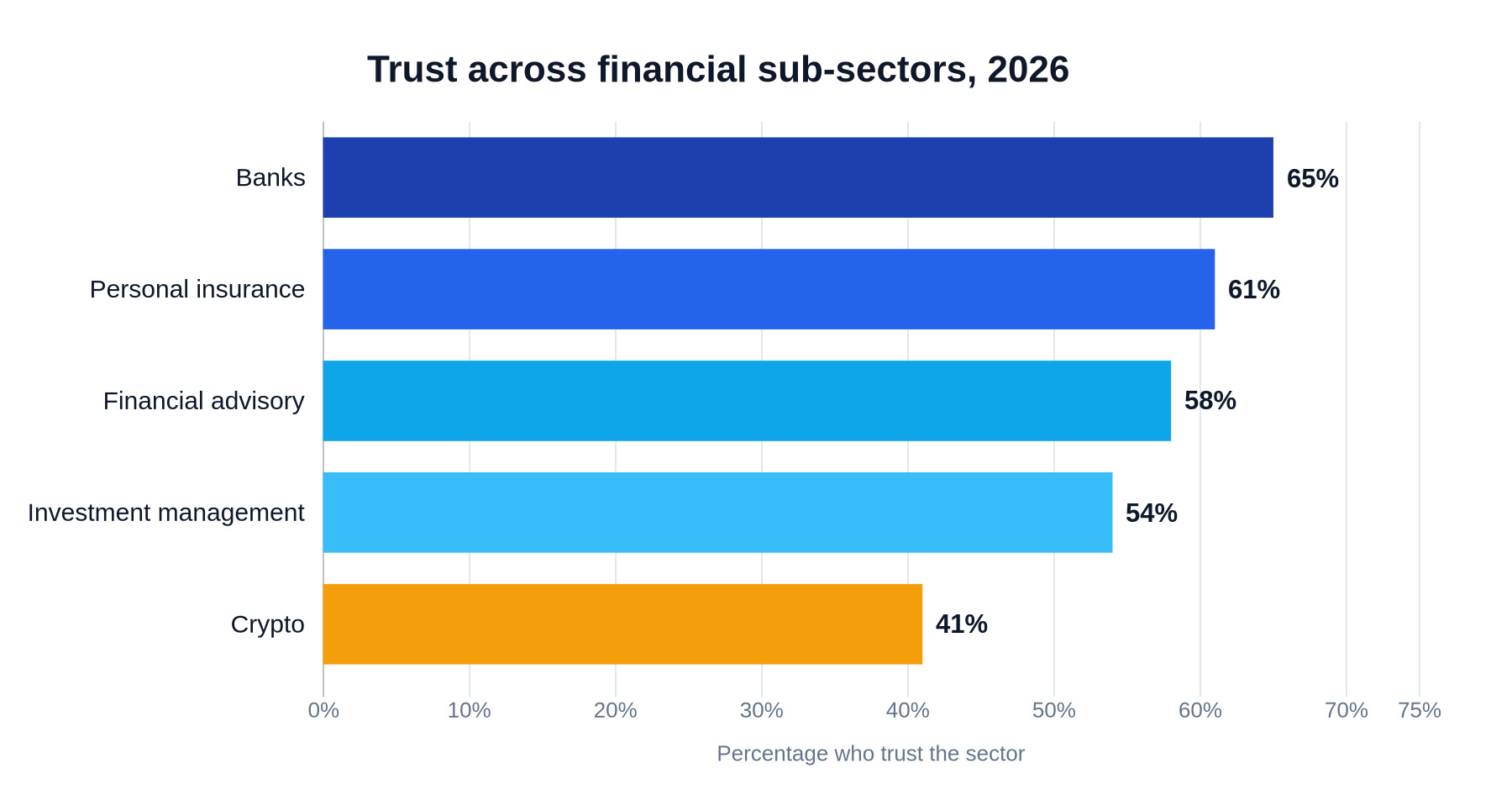
Trust in financial services reached 63% in 2026, a 10-point rise over five years and the only sector with double-digit growth since 2021. Banks are at 65%, and crypto lies at 41%. The study covered 33,938 people across 28 countries (Edelman Trust Barometer, 2026).
This gap between banking and crypto makes the whole argument. While being the same broad categories, they are 24 points apart. Also, note that trust is not evenly given, and a challenger brand starts nearer the bottom of that range than the top.
6. Trust moves into the marketing
The cost of losing trust is quite easy to price. A data breach costs a financial firm $6.08 million on average, 22% more than the all-industry figure of $4.88 million, making finance the second most expensive sector after healthcare (IBM, 2024).
The change lies in where trust gets built. It used to live in compliance disclosures and a security badge in the footer. Now, it shows up when a fintech openly talks about fees, outages, and mistakes in its marketing.
Start here: Put your security posture, your fee structure, and your incident history where a prospect finds in two clicks. Transparency does the acquisition work now, apart from retention work.
7. Founder-led content pushes back against AI-written feeds
As AI-written content takes up every channel, the brands standing out are going the other way - named people, writing in their own voice, about decisions.
Monzo is an important example of this. Co-founder Tom Blomfield has written openly about how the bank grew. He says it reached its first million customers "without having spent any significant money on marketing", and that its referral feature drove "about 40% of our signups in 2017" at no cost (Tom Blomfield, July 2022).
This is harder to fake. It needs an actual founder or executive publishing regularly.
Do this: Get one senior person publishing consistently about product decisions and related mistakes. It works because it is the opposite of what AI produces by default.
Distribution is moving off paid channels
The last five shifts are all versions of the same thing: build or borrow distribution instead of renting it out every month.
8. Community-led growth beats the paid one on cost
More and more fintech brands are building owned communities on Discord, Telegram and private forums instead of renting attention through paid socials. The appeal is structural: A community keeps producing referrals, product feedback and support deflection long after a launch push stops.
This shows up most in crypto and trading, where community trust often decides which platform wins between two similar products. It is now spreading into neobanking and B2B.
Try this: Before adding another paid channel, ask whether that budget could seed a community instead. Go slower in month one, and you will see it getting cheaper in six months.
9. Embedded finance shifts you from direct to partner-led
When your product is inside someone else's checkout or app, the person you have to convince is not the end user, but the platform that will carry you to its own users.
This changes the growth motion: Instead of optimising paid social for individual sign-ups, you are doing partnership development, co-marketing, and integration content aimed at platform decision-makers.
Do this: If your product could plausibly stay inside another company's flow, see partner content such as case studies, integration docs and API-first landing pages as an acquisition channel.
10. Niche creators replace celebrity endorsers
A smaller trusted audience converts better for a financial product than a large generic one. Creators who cover a specific corner of finance bring an audience that already trusts them on money, and that is most of the work.
The only trade-off is compliance. Creator partnerships in fintech need disclosure and pre-approval on each post. This may slow the programme down, but it is not optional.
Start here: Build a roster of niche financial creators before chasing one big name. Put compliance review into the campaign timeline from first day onwards.
11. Short-form video becomes an acquisition channel
Initially, videos used to stay in the brand budget, apart from performance. But for fintech, it does a job that long explainer articles used to do alone: breaking down a fee structure in less than a minute. It is also where younger users look for financial information before they open any search engine.
Do this: Take your three best-performing written explainers and repurpose them as short-form videos. See video format as the primary version for this sort of content.
12. App store optimisation matures into its own discipline
A research forecast said that 53% of the world's population would use digital banking by 2026, or more than 4.2 billion people, up from 2.5 billion in 2021 (Juniper Research). That forecast is now the reality most fintechs are getting into, and it makes the app store a top-of-funnel surface rather than a place people land after deciding.
Ratings, keyword targeting, screenshots and localisation are being run as their own discipline in 2026, with dedicated tooling and headcount, the same way SEO earned its own team a decade ago.
Start here: View your app store listing like a landing page, because it is the one for a large share of prospects. Review it as carefully as your homepage.
The Bottom Line on Fintech Marketing Trends 2026
None of the above twelve shifts can stay optional. AI already decides who gets shortlisted, acquisition costs are not going back down, and the brands gaining ground perceive trust, retention and owned distribution as growth channels.
But, you should not try to act on all twelve together. Pick the two or three closest to your product. Consumer fintech should look most at video modes, creators and the app store. B2B fintech should look towards more at AI search visibility and trust indicators. Run this audit this quarter and revisit the rest in six months.
We, at Clickeon, build the growth systems behind shifts like these for fintech and forex brands. Our fintech marketing services and industries pages set out the approach, and our case studies show how looked like in practice. If you want to know more on which two shifts matter most for your product, contact our team.
FAQs
What is the biggest fintech marketing trend for 2026?
It is AI search visibility. Ranking on Google doesn't guarantee that a fintech gets surfaced when someone asks an AI assistant for a recommendation. Yext found 86% of what those assistants cite comes from sources brands already control, mostly their own websites and listings. This makes your own data accuracy a bigger lever than press coverage, which is the reversal of how most fintech marketing teams have worked for a decade.
Why is fintech customer acquisition cost rising?
Paid channels have grown more competitive while privacy changes have shrunk third-party targeting data. SMB fintech now pays around $1,450 per customer and paid search in finance costs $74.44 per lead. Those are sign-up costs, and most applicants do not finish onboarding, so the cost of an active customer is higher still. This is pushing budget toward content, community, and retention.
How do I make my fintech visible in AI search?
Start with your own site and your listings, since that is where 86% of AI citations come from. Ensure that your name, credentials, pricing and disclosures say the same thing everywhere a model can find them. Inconsistency is the main reason for a brand to get skipped. Structured and machine-readable data about who you serve and on what terms is more important now than a persuasive copy.
Is influencer marketing worth it for fintech brands?
Usually yes, if creators are picked for relevance rather than audience size. A creator who covers personal finance for a small engaged audience converts better than a large general account, because trust on money topics does not transfer from unrelated content.
However, you must budget for compliance. Every post needs disclosure and pre-approval, which adds time to the campaign.
Do these trends apply to both B2B and B2C fintech?
Majority of them do, but with different weights. B2C is affected most by the video, creator and app store shifts. B2B feels the impact of AI search and trust shifts, because buying committees increasingly use AI tools to build a vendor shortlist before anyone takes a sales call. And the economics behind all twelve, rising acquisition cost against flat budgets, apply to both.
Which trend should a small fintech team start with?
Firstly, you must fix your data consistency. It costs the least and takes days, and it is also the input to AI search visibility, which lies upstream of everything else. Once your name, claims and disclosures match everywhere, move to whichever of retention or owned content your numbers call the weakest.
This article covers marketing and industry data current as of September 2026. It is guidance on marketing strategy, not financial, legal or regulatory advice.