
Key Takeaways
- Financial services marketing is won on credibility signals much before a price or product comparison.
- Compliance is a growth lever. Regulator-aligned messaging builds the authority both customers and AI search engines reward.
- Integration beats intensity. Returns compound when SEO, paid, content, email, and PR share data and attribution.
- Measurement comes before personalization. Brands that buy personalization tools before fixing attribution cannot tell what worked.
- Regulated marketing holds immense value for specialists. Compliance fluency and high-CPC discipline are learned inside the vertical.
Table of Contents
- What Is Financial Services Marketing?
- Why Did 2026 Raise the Stakes for Finance Brands?
- How Does Compliance Become a Marketing Advantage?
- Which Digital Channels Matter, and How Do They Connect?
- How Do You Measure Financial Services Marketing?
- Personalization and AI: The 2026 Growth Engine
- What Does "Good" Look Like in 2026?
- How Clickeon Builds Growth for Regulated Brands
- What This Means for Your Brand in 2026
- Frequently Asked Questions
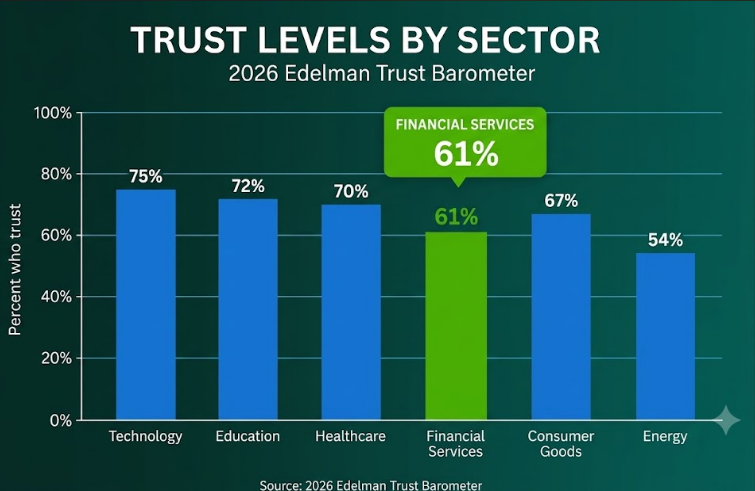
Financial services marketing in 2026 works on a paradox: customers want bank-grade trust as well as consumer-app convenience at the same time. Trust in financial services rose to 63% globally in 2026, a 10-point gain over five years. Yet, 61% of consumers now expect their financial institution to know them and understand their needs (MX's 2026 Consumer Research). Winning this requires a discipline many industries don't face: growth and regulation, integrated.
This guide is the parent reference for the topic. It maps the compliance reality, the channels, the measurement spine, the role of AI, and how a specialist team converts it all into a pipeline. Whether your focus is retail banking, fintech marketing, crypto marketing, or forex marketing, the operating logic remains the same: connect the system, prove every claim, measure end-to-end.
What Is Financial Services Marketing?
Financial services marketing is the practice of attracting, converting, and retaining customers for regulated money products under strict advertising rules, across banking, lending, investing, payments, crypto, forex, and insurance. It differs from standard B2C work in one way: each claim is a regulated statement, and each channel is a compliance surface.
The category spans two motions: Acquisition moves a prospect from awareness to a funded account. Then, lifecycle marketing deepens that relationship through cross-sell, retention, and advocacy. And the economics is more inclined toward the second. Loyalty research from Bain & Company's Frederick Reichheld found that increasing retention by 5% can improve profits by 25% to 95%, first documented in retail banking (Harvard Business Review).
One thing determines almost every downstream decision: whether the brand sells to businesses or consumers.
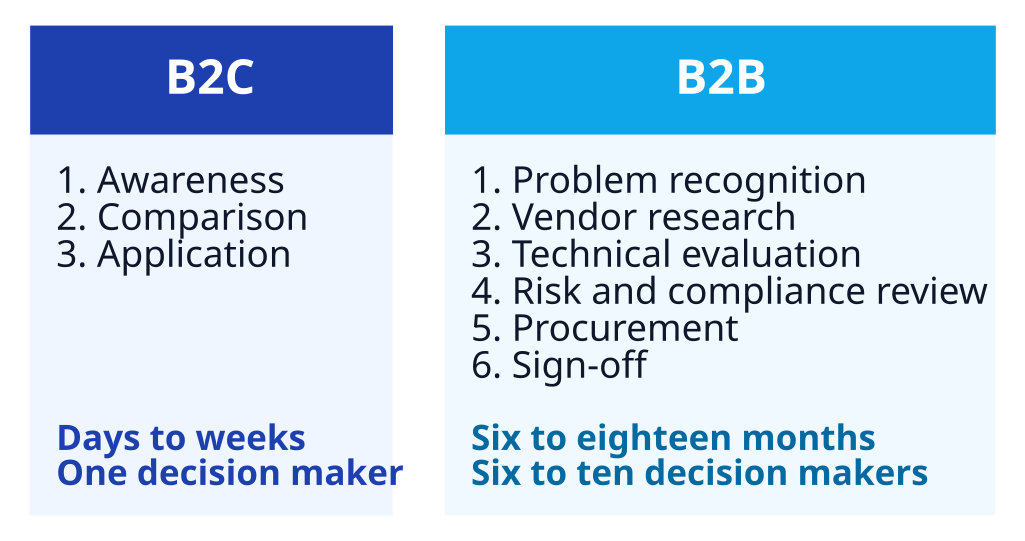
- B2C (retail banking, consumer fintech, trading apps, personal insurance) targets individuals on short funnels, leaning on security, convenience, and aspiration at high volume and lower order value.
- B2B (payment infrastructure, institutional lending, treasury, B2B fintech) sells to committees over months, rewarding technical documentation, compliance assurances, and account-based outreach.
These two need a different set of channel mix, messages, and sales cycles, so a strategy that blends them without distinction generally underperforms.
Why Did 2026 Raise the Stakes for Finance Brands?
A clear reason is that the cost of getting it wrong is regulatory. A misleading promotion triggers penalties, and that sets the tone for every decision from headline copy to cookie banner.
"Over the last decade, society has devolved from fears to polarization to grievance."
- Richard Edelman, CEO, Edelman, [2025 Edelman Trust Barometer]
Three forces define the environment, and the first sets the path for the rest:
- A trust deficit across institutions: Skepticism is the default setting. The rise in trust noted above is real, but Edelman still ranks financial services toward the lower end of the 17 industries it measures, so confidence is recoverable, but not yet recovered.
- AI-mediated discovery: Google's AI Overviews and assistants like ChatGPT and Perplexity answer money questions directly, so visibility increasingly means becoming the source for AI citations.
- Tighter data rules: Privacy regulation and the loss of third-party cookies restrict the targeting marketers rely upon, pushing first-party data to the center of every plan.
How Does Compliance Become a Marketing Advantage?
In a regulated category, the claims you cannot substantiate matter just as much as the ones you can, and documenting both is where credible messaging starts. For modern discovery, be it human or AI, clear disclosures, verifiable claims, and transparent terms play a key role in building trust.
For brands operating across forex, CFD, and crypto markets, the regulatory map runs wider than the expectations of marketers. Australia's ASIC governs financial-product advertising under RG 234, entailing balanced messaging and clear risk disclosure. Cyprus's CySEC supervises the investment firms that anchor most of the global forex industry, enforcing standardized risk warnings, leverage limits and oversight of affiliates and finfluencers. Across the EU, MiCA governs crypto-asset marketing: under Article 66, every communication must be fair, clear, and consistent with the published white paper.
| Regulator | Jurisdiction | What it governs in marketing |
|---|---|---|
| CFPB | US | UDAAP; bars unfair, deceptive, or abusive practices |
| SEC/ FINRA | US | Investment claims, disclosures, suitability |
| FTC | US | Truth-in-advertising, endorsements, CAN-SPAM |
| FCA | UK | Financial promotions must be pre-approved by an authorized person |
| ASIC | Australia | Advertising of financial products and credit; balanced, not misleading (RG 234) |
| CySEC | Cyprus/ EU | Forex and CFD risk warnings, leverage caps, affiliate and finfluencer oversight |
| MiCA (ESMA) | EU | Crypto-asset marketing must be fair, clear and consistent with the white paper (Art. 66) |
In our work building growth programs for trading and fintech brands, the campaigns that scale smoothly share one feature: Compliance is integrated in the room from day one. Building that review into the production process, rather than bolting it on at the end, is what keeps campaigns shipping on schedule.
In practice, it means three things run in parallel:
- A claims register lists every statement the brand is permitted to make and the evidence behind each one, so writers work from an approved vocabulary instead of doing guesswork.
- A disclosure library holds the risk warnings and terms for each jurisdiction, versioned so no one picks up last year's wording.
- A named reviewer owns sign-off with a fixed turnaround, which prevents compliance from becoming the bottleneck teams complain about.
Brands that build these three assets stop re-litigating the same questions on every other campaign.
Want compliance built into your campaigns from day one?
Book a meeting with our team to map your claims register, disclosures and review flow before your next campaign goes to legal.
Book a meeting →Which Digital Channels Matter, and How Do They Connect?
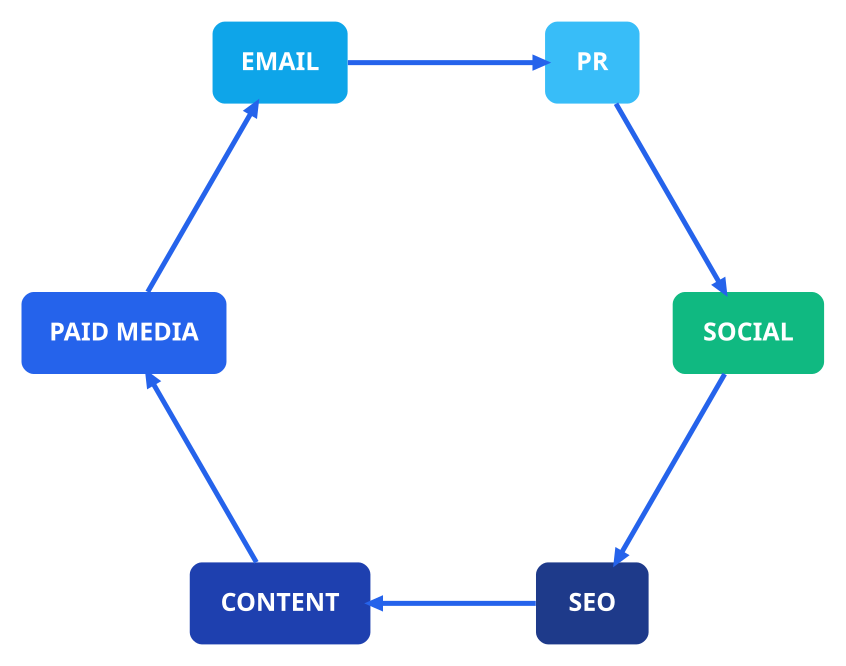
Six channels carry most of the load, and the connections between them are particular. SEO and content earn authority that makes paid media cheaper to convert. Paid generates the audience signals that sharpen email and CRM. Email strengthens relationships that PR and social amplify as proof. PR feeds the authority signals SEO and AI search reward, thus closing the loop.
| Channel | Primary role |
|---|---|
| SEO & AI search | High-intent discovery and AI citation |
| Paid media | Fast, measurable acquisition |
| Content & education | Trust-building and AI extraction |
| Email & CRM | Lifecycle value and retention |
| PR & distribution | Third-party authority |
| Social & influencer | Reach and humanization |
- SEO and AI search: Search is where high-intent financial decisions begin, and in 2026 that includes AI answers as much as blue links. Ranking for money keywords requires demonstrable E-E-A-T, because both Google and AI engines weight source credibility heavily for "Your Money or Your Life" topics. This is the discipline at the heart of financial services SEO. It now extends into generative engine optimization, where structured data, clear entity definitions, and quotable statistics make a page easy for a model to lift and attribute. Our financial services digital marketing guide goes deeper on this.
- Paid media and performance: Finance and insurance keywords convert at a 2.64% rate on average in Google Ads (WordStream), and cost-per-click is among the highest of any vertical, so efficiency depends on audience precision and compliant creative. Spend is shifting toward connected TV and precision digital (Innovid Financial Services Advertising Outlook, 2026). Creative constraints are unusually tight. In forex marketing and crypto marketing, platforms and regulators require prominent risk warnings, ban performance claims, and restrict targeting, so the work is as much about clearing review as creative quality.
- Content and education: Calculators, explainers, and guides answer the questions prospects already ask, and they double as the raw material AI engines extract. Video has become central: short-form explainers and financial-literacy series now dominate for products consumers would never read a white paper about. The key point: research in the Journal of Business Research found consumers perceive communications they believe were AI-authored as less authentic, which erodes loyalty (Kirk & Givi, 2025). Simply put, AI-assisted and human-authored expertise wins, instead of automation alone.
- Email, CRM, and lifecycle: Finance-category email open rates run near 33% (Mailchimp, 2026), above many consumer industries, which makes lifecycle automation one of the highest-ROI investments available. The gains come from connecting behavioral signals such as transaction history, product usage, and journey stage to messaging that meets a customer at the point they are.
- PR and distribution: PR gets third-party validation that paid channels cannot buy. In other words, placement in respected financial outlets, expert commentary and a credible publisher network reinforce the authority signals driving both human trust and AI citation. For regulated brands, earned media also creates a controlled environment to communicate without the claim-by-claim scrutiny of paid ads.
- Social and influencer: Social is where finance brands humanize complex products and reach younger audiences, increasingly through creator-led education. Investment is increasing here: 89% of FinServ marketers plan to increase influencer spend and 70% plan to increase social spend, per Innovid Financial Services Advertising Outlook. But creator partnerships carry disclosure obligations, and regulators like CySEC now scrutinize finfluencer activity.
Mapping Channels to the Funnel
| Funnel stage | Goal | Lead channels |
|---|---|---|
| Awareness | Be discovered and remembered | SEO/AI search, PR, social, connected TV |
| Consideration | Build trust and answer objections | Educational content, video, retargeting, email nurture |
| Conversion | Move to a funded account | Paid search, comparison content, optimized landing pages |
| Retention & advocacy | Deepen and extend the relationship | Email/CRM lifecycle, loyalty, community, referral |
How Do You Measure Financial Services Marketing?
This is measured with attribution that survives a six-week consideration window, which rules out last-click. Finance carries high CPCs and long decision cycles, so the measurement layer has to connect an ad impression to a funded account weeks later. You must get it right first, and then every downstream decision (budget, audience, creative) gets much easier.
Our team often observes that brands buy personalization tools before they have fixed their attribution. Last-click hands the credit to the final touch, usually a branded search or direct visit, and starves the awareness and consideration channels that did the persuading. When a customer takes six weeks and a dozen touchpoints to open an account, last-click systematically misreads what worked. Multi-touch attribution distributes credit across the journey, so the explainer video and the comparison page get the recognition the branded click just closed.
The non-negotiables for a finance measurement stack:
- Server-side tracking that survives cookie loss and browser restrictions.
- Consent-aware analytics that respect privacy regulations by default.
- A single source of truth tying every dollar of spend to downstream revenue.
Without that martech foundation, every other optimization is guesswork.
In practice, this gets narrower than vendor pitches usually suggest. Server-side tracking means events fire from your infrastructure, so ad-blockers and cookie restrictions stop silently deleting conversions. Consent-aware analytics means the measurement layer reads the consent record before it processes anything, in place of collecting first and filtering later. And a single source of truth generally means one warehouse where ad spend, CRM stage, and funded-account data are on the same table.
First-Party Data in a Cookieless World
Cookie deprecation and tightening privacy regulations have turned first-party data from a nice-to-have into the core asset of a finance marketing program. It is the information customers share directly: account activity, on-site behavior, preferences, consented contact details. As it is collected with permission and owned by the brand, it is more durable and compliant than the third-party indicators marketers are losing.
A practical strategy has three moving parts:
- Collection: Progressive profiling, gated calculators, and preference centers that give customers a reason to share data in exchange for genuine value.
- Consent management: A transparent and auditable record of what each customer agreed to, integrated into each downstream system so consent travels with the data.
- Activation: A unified customer profile feeding personalization, suppression, and measurement, without leaking regulated information.
Built correctly, this foundation powers attribution, sharpens AI personalization, and keeps the brand aligned with IAB guidance on first-party data.
Personalization and AI: The 2026 Growth Engine
With the measurement spine in place, personalization is not guesswork. It is now the baseline expectation in financial services, and AI makes it scalable.
"Companies that grow faster drive 40 percent more of their revenue from personalization than their slower-growing counterparts."
- McKinsey & Company, [Next in Personalization, 2021]
McKinsey's related analysis estimates personalization at scale can lift revenue by 5 to 15% while reducing acquisition costs, so the gains show up on both sides of the ledger.
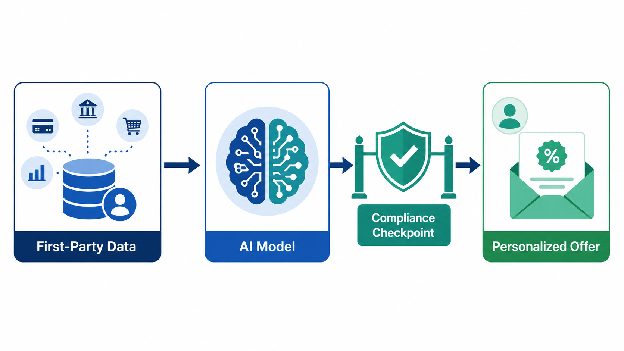
Consider a lending brand with a funded-account journey that stalls at document upload. Personalization here is recognizing the stall from behavioral data and triggering a help sequence that names the missing document. This requires consented first-party data, a governed model, and a human owner for the message, all of which most brands have.
The constant constraint is governance. Brand safety and compliance are the barriers finance marketers cite when scaling AI (Innovid FinServ Outlook, 2026), and in a regulated category those concerns are fully valid. The answer lies in building the guardrails that let personalization run safely: approved claims, audit trails, and human review of customer-facing things.
What Does "Good" Look Like in 2026?
Your own clean baselines matter more than an industry average, so read these as direction rather than goals.
| Metric | 2026 benchmark | Source |
|---|---|---|
| Email open rate (finance category) | ~33% | Mailchimp |
| Google Ads conversion rate (finance & insurance) | ~2.6% | WordStream, 2026 |
| Global trust in financial services | 63% | Edelman, 2026 |
| FinServ marketers raising influencer spend | 89% | Innovid/ Mediaocean, 2026 |
| Retention economics | +5% retention ≈ +25-95% profit | Bain/ Reichheld (HBR) |
Each number shifts for its own reasons:
- The email figure tracks list hygiene and send cadence.
- The conversion rate tracks keyword intent and landing-page match.
- The trust number tracks the sector, not campaigns.
How Clickeon Builds Growth for Regulated Brands
Clickeon is built specifically for regulated finance brands across crypto, forex, and fintech, and this focus separates specialist execution from generalist marketing. Its model pairs an advisory layer (GTM strategy, martech and attribution, AI marketing automation) with execution engines in paid media, AI and SEO, and PR and distribution, designed to compound rather than operate in isolation. Here is the full structure of Clickeon's services.
The proof points map to the disciplines in this guide: more than $5M in managed ad spend, and 50+ clients across 30+ countries. The in-house publisher network of forex review sites carries 300k+ monthly users. Real-world outcomes are documented in Clickeon's case studies.
What This Means for Your Brand in 2026
Financial services marketing in 2026 rewards brands that treat trust as infrastructure: compliant by design, personalized with governance, measured end to end. The shift is from chasing reach to engineering credibility, the asset that earns both customer confidence and AI-search visibility. Brands that connect their channels into single accountable system compound growth, unlike the ones running scattered campaigns.
Ready for a candid audit?
See where your trust signals, channel integration and attribution are leaking funded customers.
Request your financial services marketing audit →Frequently Asked Questions
What is financial services marketing?
Financial services marketing is the regulated practice of acquiring and retaining customers for money products, with each claim being a supervised statement. Oversight comes from bodies including the CFPB, SEC, FCA, FTC, ASIC, CySEC and the EU's MiCA regime, each with its own rules on disclosures, performance claims and affiliate conduct. In practice, here, legal review belongs inside the production process. Campaigns that treat it as a final checkpoint often stall before launch.
How is digital marketing for financial services different from other industries?
It's different in three ways: Customer-acquisition costs are among the highest of any vertical, so wasted spend compounds faster. Claims must be substantiable and disclosures are mandatory, which narrows the creative space considerably. And "Your Money or Your Life" content is held to higher credibility standards by search engines and AI assistants alike. Authorship, sourcing, and expertise carry weight here, unlike in unregulated categories. The result is a discipline where the compliance layer and the growth layer have to be designed together.
Which marketing channels work best for financial services in 2026?
The strongest results come from connecting channels instead of ranking them. That looks like an SEO-cited explainer feeding a retargeting audience, which warms a prospect for a paid-search conversion, after which an email lifecycle journey cross-sells a second product. Judged individually, paid search converts fastest and email returns the most per dollar, but neither performs at its ceiling without the authority that content and PR build upstream.
Is AI safe to use in financial services marketing?
AI is safe and valuable when governed properly. You can use it for data analysis, campaign optimization, and content acceleration, but keep a named human accountable for each claim and maintain a clean consent trail. The specific risk in this category is that sometimes it produces plausible unsubstantiated claims at speed, in a context where an unsubstantiated claim is a regulatory event. Governance has to come before scaling happens.
What should financial brands look for in a specialist marketing agency?
These brands should look for genuine compliance fluency, demonstrable E-E-A-T credentials, experience in high-CPC paid environments, attribution-grade measurement, and an owned distribution or publisher network. Ask to see how a campaign moved through legal review, apart from what it delivered. Specialist agencies usually outperform generalists for regulated brands because those capabilities are learned inside the vertical, not transferred from a general playbook.