

Key Takeaways
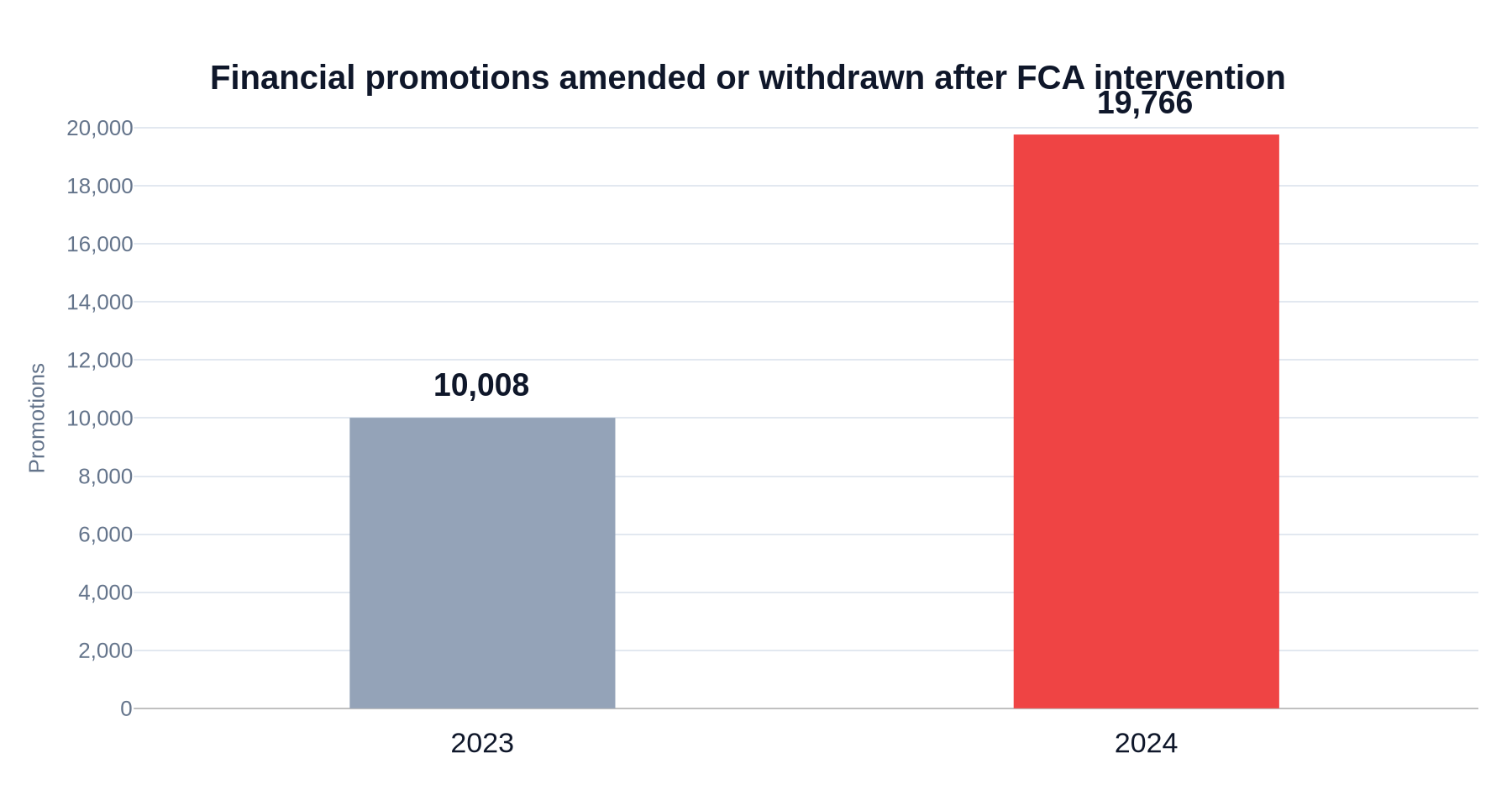
- Compliance is the defining constraint in digital marketing for financial services. UK authorised firms amended or withdrew 19,766 financial promotions in 2024 after FCA intervention, nearly double the 10,008 recorded in 2023 (FCA, 2025).
- There has been a marked increase in the use of AI for financial decisions. 49% of consumers across 23 countries used AI to help with a savings or investment decision in the previous six months (EY Global AI Sentiment Survey, 2026).
- Cheaper clicks lead to weaker conversion rates. Finance and insurance keywords average $3.39 per click and a 2.64% conversion rate on Google search ads, against an all-industry average of 8.18% (WordStream, 2026).
- Marketing decisions in the financial sector are compliance decisions. FINRA's first influencer-supervision enforcement action ended in an $850,000 fine for one firm (FINRA, 2024).
- Both regulators and search engines reward the same behaviour: Claims you can evidence.
Table of Contents
- What is digital marketing for financial services?
- What the enforcement data says about compliance risk?
- How to build a compliance-first marketing workflow?
- Which digital marketing channels work best for financial services firms?
- Generative engine optimization: getting cited by AI assistants
- How much should financial services firms spend on digital marketing?
- Why attribution matters more than the budget number?
- The Bottom Line
- FAQs
Digital marketing for financial services is one such discipline where a winning campaign and a penalty-prone one look almost identical on the way to launch. I have watched teams build a channel plan, a brief, and a landing page without a compliance touchpoint, then discover at review that the whole angle rests on a claim that can't be substantiated. The rework costs more than the media.
Here, I talk about the things that work in 2026: Data confirmed by enforcement agencies that reveal risk, channels that justify the budget, and how brands earn citations inside AI assistants.
What is digital marketing for financial services?
Digital marketing for financial services is the use of online channels (search, paid media, email, social, content, and AI assistants) to acquire and retain clients for a regulated financial brand. Each public statement counts as a regulated publication. Under FCA rules, a financial promotion must be fair and clear (FCA Handbook, COBS 4.2.1R). In the US, FINRA Rule 2210 governs member-firm communications, and SEC-registered advisers work under the Marketing Rule (SEC, 2024).
This difference reshapes everything that goes downstream. Financial services' digital marketing runs on a distinct objective function: conversion rate subject to a constraint, where nothing in the funnel may promise a return, imply certainty, or omit a material risk.
Scrutiny is not spread evenly either. A B2B fintech selling payment infrastructure enjoys more latitude than a retail CFD broker. My rule of thumb: the closer your product is to a consumer's own money, the tighter the leash.
The three questions that set your risk profile:
- Who is the audience? Retail consumers fetch heavier scrutiny than institutional or B2B buyers.
- What is the product? Complex products, leverage, crypto, and high-yield propositions lie at the top of every regulator's watchlist.
- Who speaks on your behalf? Affiliates, introducing brokers and influencers become your communications, and therefore your supervision burden.
What the enforcement data says about compliance risk?
The 2024 numbers give the sharpest available picture of where regulators are actually looking. In the UK, authorised firms amended or withdrew 19,766 financial promotions following FCA intervention, a 97.5% increase on the 10,008 recorded the year before. The FCA also issued 2,240 alerts about unauthorised firms, interviewed 20 finfluencers under caution and issued 38 alerts against finfluencer accounts (FCA, 2025).
Across the Atlantic, FINRA resolved roughly 523 matters through Letters of Acceptance, Waiver and Consent during 2024, around 70% against individuals and 30% against member firms (CSG Law analysis of FINRA data, 2025).
One correction is overdue, because the opposite claim circulates widely: communications and advertising were not among the most frequently cited FINRA violation categories during 2024. The recurring ones were Regulation Best Interest, trade reporting, AML, net capital, recordkeeping, and excessive mark-ups. US advertising exposure is concentrated rather than routine.
FINRA's targeted social media sweep shows why. The regulator examined more than 1,000 influencer posts and found about 70% carried substantive compliance problems: 55% never disclosed the post was paid, 38% omitted risks, 30% made misleading claims. FINRA's advertising chief put the lesson plainly:
"Firms need to think through the impacts that new marketing strategies can have on their communications compliance."
- Ira Gluck, Senior Director of Advertising Regulation, FINRA (FINRA Unscripted, 25 June 2024)
The first formal FINRA action on influencer supervision made the point concrete. M1 Finance was fined $850,000 in March 2024 after roughly 1,700 influencers promoted it between January 2020 and April 2023, generating 39,400+ accounts. The firm didn't review, approve, or retain what any of them said (FINRA, 2024).
An entire acquisition channel ran for three years with zero supervisory layer beneath it.
How to build a compliance-first marketing workflow?
A compliance-first workflow puts review ahead of spend, much before publication. Checking at publication catches the weak creatives. It cannot rescue a flawed proposition that has already burned a quarter's budget. In our work with forex, crypto, and fintech brands across 30+ countries, the teams that move fastest front-load this.

Four things hold most of the weight:
Pre-approve at concept stage: Walk the campaign proposition past compliance before a designer opens a single file. A claim that fails review disapproves a headline, and a proposition that fails review kills a quarter.
Hand the marketing team a claims library: Document what the firm may and may not say, with evidence beside each permitted claim. Many compliance failures are not defiance, but guesswork.
Archive by default. FINRA obliges member firms to preserve every communication issued on their behalf. Its 2026 oversight report extends that expectation to GenAI chatbot conversations with customers (FINRA 2026 Annual Regulatory Oversight Report, via McGuireWoods, December 2025). If your retention story stops at the website, it is incomplete.
Supervise every mouth you pay for: Affiliates, IBs, and influencers speak as you. Contractual language alone is not supervision. Contract plus pre-approval plus monitoring plus retention is.
There is a commercial argument here too: Substantiated content survives an editorial standards check, and it is also what search engines and AI models prefer to cite. My take: firms that treat compliance as a content quality filter outperform organically against those treating it as a legal tax. That is a pattern we observe in client work.
Is your next campaign compliance-ready?
Book a meeting with our team to walk your proposition, claims and approval workflow through a regulated-marketing lens before you spend.
Book a meeting →Which digital marketing channels work best for financial services firms?
Organic search delivers the best long-run economics for most financial services firms, paid search delivers the fastest qualified traffic at a below-average conversion rate, and email delivers the highest engagement of any owned channel. Finance and insurance campaigns average $3.39 per click and convert at 2.64% on Google search, against an all-industry average of $5.42 and 8.18% (WordStream, 2026). Cheaper clicks worsen the conversion rates.
| Channel | Best for | Sourced benchmark | Compliance note |
|---|---|---|---|
| Organic search / SEO | Long-run acquisition, topical authority, AI citation | Compounding: cost per lead falls as the asset ages; no per-click cost | Content counts as a financial promotion. YMYL quality standards apply |
| Google paid search | High-intent bottom-of-funnel capture | Finance & insurance: $3.39 avg CPC, 9.83% CTR, 2.64% conversion, $74.44 cost per lead (WordStream, 2026) | Ad copy and landing page both need pre-approval. No implied guarantees |
| Retention, nurture, cross-sell | Business & finance: 31.35% average open rate, 2.78% click rate (Mailchimp, December 2023) | Archive everything. Unsubscribe mechanism required | |
| B2B fintech, institutional and adviser audiences | No Tier 1–3 benchmark we would stand behind; expect higher CPL than Google, better fit for long sales cycles | Lower consumer-harm exposure, same substantiation rules | |
| Meta / consumer social | Brand awareness, consumer fintech scale | Lower intent than search; treat as reach, not capture | Every post is a regulated communication. Influencer posts must be supervised |
The channel split matters less than the fit. A digital marketing strategy for financial advisors managing local HNW relationships shares almost no tactics with one for a licensed FX broker acquiring across a dozen jurisdictions. Ours starts with the licence map, because the licence decides where you may advertise at all. You can see how that plays out in our fintech marketing case studies.
Generative engine optimization: getting cited by AI assistants
Generative engine optimization (GEO) is the practice of structuring content so AI assistants cite your brand when they answer a question. It is crucial because the research step has moved. J.D. Power survey found 51% of consumers turn to AI for financial advice or information (ABA Banking Journal, 2025), and 49% of respondents across 23 countries told EY they had used AI to support a savings or investment decision in the previous six months (EY Global AI Sentiment Survey, May 2026).
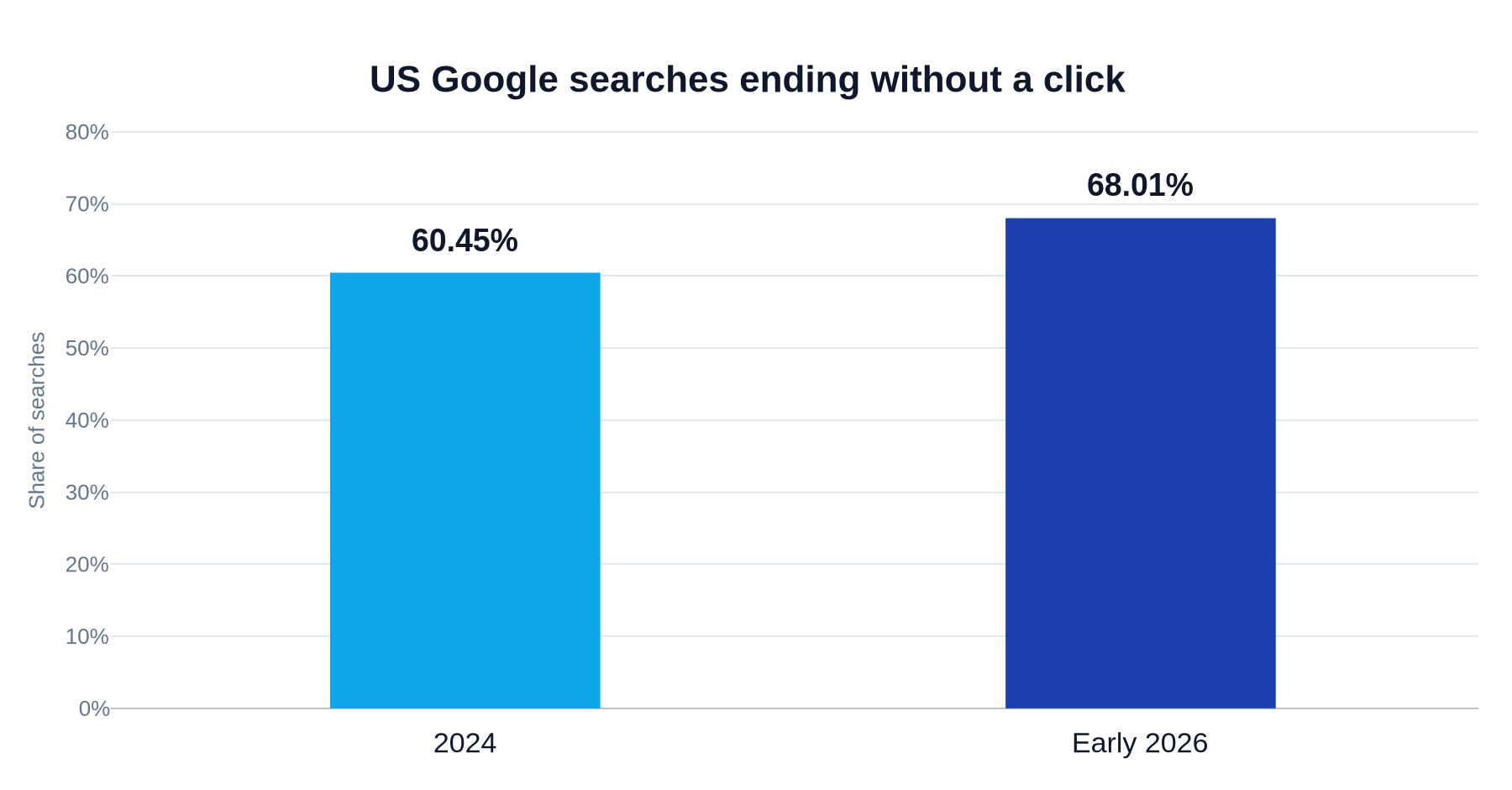
Meanwhile, the click is disappearing. SparkToro found 68.01% of US Google searches ended without a click in the first four months of 2026, up from 60.45% in 2024, with click-through rates falling close to 60% where an AI Overview appears (Search Engine Land, 2026).
So the visibility question has changed shape. It is no longer only "do we rank" but "when an assistant answers this, are we in the answer?" Four things impact it:
- Open every section with a standalone answer: Fifty to eighty words that make complete sense pulled out of context, leading with the answer rather than the setup. Nothing else affects extraction rates as much.
- Attach a named source and a year to every number: In finance, an unsourced statistic is a serious citation problem.
- Build a real FAQ block: Five or more genuinely standalone questions and answers, each one useful without the article around it, marked up with FAQ schema.
- Keep entity signals consistent: Brand name, regulatory status, jurisdictions, and specialisms stated the same way everywhere, so models build an accurate picture of you.
GEO is not a separate discipline from SEO. It is the same standard held more strictly, and the discipline compliance already compels that when you cite it, you date it without overclaiming, and this is what AI systems reward.
How much should financial services firms spend on digital marketing?
There is no such published benchmark for financial services marketing spend as a share of revenue that is solid enough for us to put our name to. Treat the framework below as our starting position from client work.
| Stage | Annual revenue | Marketing as % of revenue | Where we would put it first |
|---|---|---|---|
| Early | Under $1M | 15-20% | Search-led content, founder-led LinkedIn, one paid channel |
| Growth | $1M–$10M | 10-15% | SEO plus paid search plus lifecycle email |
| Scale | $10M+ | 7-12% | Full mix, brand investment, programmatic |
The useful anchor here is cost per acquisition measured against lifetime value. The table above puts the average finance and insurance cost per lead at $74.44 (WordStream, 2026). Apply your own lead-to-client rate before deciding whether a channel is affordable. A fintech with a sharp ICP runs well below this framework. A financial adviser fighting robo-advisers in a crowded metro may need more than the top of it.
If you want to see how we scope this for regulated brands, our fintech marketing services and industries pages cover the approach.
Why attribution matters more than the budget number?
Attribution is where financial services marketing budgets are won and lost, because the sales cycle outruns the reporting window. An enquiry that starts with a search in March may not close until June, so a month-end dashboard will consistently mis-rank your channels. Three fixes do most of the work.

- Pass the source into the CRM, apart from analytics: If the source dies at form submission, every downstream decision is guesswork.
- Report on a cohort basis: Group leads by entry month and follow that cohort to close. Comparing this month's spend to this month's revenue compares two unrelated things.
- Instrument the phone: In many financial verticals, the highest-intent enquiries arrive by call. An untracked call is an unattributed channel.
I would rather work with a firm spending 8% of revenue with clean attribution than one spending 15% blind. The second firm is just guessing at scale.
The Bottom Line
Digital marketing for financial services works when the compliance constraint is treated as a content standard rather than an obstacle. The 2024 enforcement data is unambiguous: regulators are intervening at scale on promotions, hardest on communications made by third parties. The same discipline that keeps you out of that data (named sources, dated figures, no unsubstantiated claims) earns organic rankings and AI citations.
Get the sequence right: fix substantiation first, structure content so it can be quoted, then buy traffic. The reverse order is how firms end up with expensive traffic pointed at claims they cannot defend. For deeper scrutiny, contact our team that works with regulated financial brands across more than 30 markets.
FAQs
Is digital marketing for financial services different from other B2B or consumer marketing?
Yes, in one specific way: every public communication is a regulated publication. In the UK, a financial promotion must be fair, clear, and not misleading under FCA rules. In the US, FINRA Rule 2210 governs member-firm communications and the SEC Marketing Rule governs registered advisers. That changes what you can claim, who approves it, and how long you retain it. The channels are the same channels everyone else uses.
Which channel should a financial services firm start with?
Start with organic search if you have twelve months of runway, and with paid search if you need pipeline this quarter. Finance and insurance paid search averages $3.39 per click and converts at 2.64%, below the 8.18% all-industry average (WordStream, 2026), so paid only works when your offer and landing page are genuinely strong. Organic costs more time and less money, and the asset keeps returning after you stop paying.
How do financial services firms get cited by ChatGPT and other AI assistants?
By publishing content that is structured for extraction and easy to verify. Open each section with a fifty-to-eighty-word standalone answer. Attach a named source and year to every statistic. Add a real FAQ block marked up with schema, then describe your brand, regulatory status, and specialisms the same way everywhere. AI systems favour content citing verifiable authorities over content that asserts without evidence, which is why compliant financial content does well here.
What does compliance actually change about a marketing campaign?
It changes when review happens and who is inside the process. The workable model has four parts. Pre-approval at the concept stage. A written claims library with substantiation attached. Retention of every communication, including those made by affiliates and influencers. Active supervision of anyone paid to speak for the firm. FINRA's first influencer-supervision action produced an $850,000 fine against a firm whose influencer programme ran for three years without review or retention (FINRA, 2024).
Do banks and financial advisors need different strategies?
They need different starting points. Digital marketing for banks is usually a local and trust-led problem, weighted toward branded search, reputation and product-comparison content. Digital marketing for financial advisors is a relationship problem, weighted toward personal authority, referral amplification and long-form educational content. A licensed multi-market broker has a third problem again, since jurisdiction determines where it may advertise at all. The channels overlap; the sequencing does not.
Do we need a specialist digital marketing agency for financial services?
Not necessarily, but regulated-industry experience is the thing to test for. An agency that has never worked under FCA, FINRA, or SEC constraints produces campaigns that generate review cycles rather than leads. Ask any prospective partner how they handle promotion approval, retention, and affiliate supervision. If they treat that as your problem rather than a shared one, keep looking.
This article is informational only and does not constitute financial, legal, or compliance advice. Regulatory requirements vary by jurisdiction and change over time. Consult a qualified compliance professional before acting on anything here.