
Key Takeaways
- Make sure your firm owns the ad accounts: Crypto ad approvals are tied to the advertiser, so the agency should work through accounts owned by your company.
- Every influencer and paid article needs the right approval and disclosure: Have your compliance team approve paid content and make sure it is clearly labelled as paid.
- Test crypto ad networks before committing a large budget: Use a fixed budget, track every click to a first deposit, and review the results before continuing.
- Measure marketing by first deposits: Track registrations, KYC passes, and first deposits for every traffic source.
- Leave token-launch services out if you are a licensed broker or exchange: Services such as quests, airdrops, and token listings are designed for token projects rather than firms trying to acquire trading customers.
Table of Contents
- What Crypto Marketing Services Include
- What Each Ad Platform Requires for Crypto Ads
- The Six Checks
- The Bottom Line on Crypto Marketing Services
- Frequently Asked Questions About Crypto Marketing Services
Crypto marketing services include the work an agency does to bring customers to your crypto business. They cover SEO, content, paid ads, influencer posts, PR, and community management.
This guide is for licensed firms that want customers to open an account, pass the identity check (KYC), and make a first deposit.
The six checks below help you spend your budget on that goal.
What Crypto Marketing Services Include
A crypto marketing package involves two kinds of work. Some services bring customers to a trading account. Others serve token projects. A licensed broker or exchange needs only the first kind.
The table shows where each service fits. The first seven rows serve a licensed firm, with conditions in some cases. The last three rows of services don't contribute to licensed firms.
| Service | What it does | Right for a licensed broker or exchange? |
|---|---|---|
| SEO and content | Brings search traffic to your own site | Yes |
| AI search (also called GEO) | Gets your pages quoted in AI answers | Yes |
| Community management | Runs your Telegram, Discord or social channels | Yes, with posts approved by your compliance team |
| Paid ads on Google, Meta, X and LinkedIn | Search and social ads for your product | Yes, where the platform has approved you |
| Crypto ad networks | Banner ads on crypto websites | Small test only (check 4) |
| Influencer posts | Paid posts by crypto influencers, also called key opinion leaders (KOLs) | Yes, with approval and a paid label on each post (check 2) |
| PR in crypto media | News coverage and paid articles | Yes, with paid articles labelled (check 3) |
| Quest campaigns | Rewards for tasks, on tools like Galxe and Zealy | No, token projects only |
| Airdrops | Free token giveaways | No, token projects only |
| Token listing support | Gets a new token listed on CoinGecko and CoinMarketCap | No, token projects only |
The six checks below explain how to handle the conditions: check 2 covers influencer posts, check 3 covers paid articles, and check 4 covers ad networks.
Quests, airdrops and listings build a token's audience, so they don't produce account openings, KYC passes or first deposits. If a proposal includes them, ask the agency to remove those lines and price the rest separately. For building long-term trust with traders, see our guide to crypto marketing strategy.
What Each Ad Platform Requires for Crypto Ads
Google, Meta, X, and LinkedIn accept crypto trading ads only from advertisers they have approved. Check your approval in each target country, because that decides where paid ads can run.
| Platform | What its policy page requires |
|---|---|
| In the UK, the advertiser must be registered with the Financial Conduct Authority (FCA), the UK regulator. In the 27 EU countries, the advertiser must be authorised as a crypto-asset service provider under the Markets in Crypto-Assets Regulation (MiCA), the EU's crypto law. In both cases, Google must also certify the advertiser. | |
| Meta | Ads for crypto trading platforms need Meta's written permission. To get it, you submit a recognised licence or registration in Meta Business Suite. |
| X | Ads for crypto exchanges and wallets are allowed once the advertiser meets the licensing rules for each country. Each type of product needs its own request to X. |
| Crypto exchange and wallet advertisers need prior authorisation. Ads may target only the US, the UK, Switzerland, Germany, France, the Netherlands and the United Arab Emirates. They must target finance professionals and may not target consumers. |
The Six Checks
1. Run Paid Ads Only in Your Own Ad Accounts
The approval in the table above belongs to the advertiser. This is why crypto ads should run in ad accounts your firm owns, with access given to the agency.
If an agency may offer an ad account that is "already approved", ask which crypto approval that account holds and whose licence it rests on. If the agency cannot tell this, do not run your crypto ads there.
Keep your tracking codes and analytics in your firm's name too. Your ads build a conversion history, and it stays even if you change your media buying agency.
2. Pay Influencers Only for Approved and Labelled Posts
In the UK, the FCA's guidance on social media promotions (FG24/1) covers influencer posts. An influencer who promotes a regulated financial product needs approval from an FCA-authorised person. Without it, the influencer may be committing a criminal offence.
In the US, the Federal Trade Commission (FTC) says the influencer and the brand must disclose a paid connection. The platform is not responsible for this. The FTC's Endorsement Guides page advises adding your own disclosure even where a platform offers a disclosure tool.
In October 2022, the US Securities and Exchange Commission (SEC) charged Kim Kardashian for failing to disclose a $250,000 payment for an Instagram post about a crypto token. She agreed to pay $1.26 million to settle.
Write three terms into the influencer contract:
- Approval: Your compliance team approves each post before it runs.
- Disclosure: The contract states the wording each post must carry to show that it is paid.
- Payment: You pay only for posts that were approved and labelled.
If an agency prices its influencers by reach, without any approval step, leave influencers out of that proposal.
3. Label Every Paid Article
There are two kinds of crypto PR. Earned coverage is a story that a journalist chooses to write. A paid article is the one you pay an outlet to publish. An agency can guarantee only a paid article.
In the EU, MiCA Article 66(2) says marketing communications from crypto-asset service providers must be identified as marketing. In our reading, a paid article is marketing and needs a label.
- Ask any crypto PR agency to mark each item in its report as earned or paid.
- Ask it to invoice paid articles separately from its monthly fee.
4. Test Crypto Ad Networks on a Fixed Budget
Crypto ad networks sell banner ads on crypto websites. A network can be worth testing in a country where you are licensed, but Google, Meta, X, and LinkedIn haven't approved you yet. Each network describes its own traffic quality, so test it before you trust it.
Set three rules for this test:
- Budget and end date: A fixed budget and a one-month end date.
- Tracking: A tag on every click, so your CRM shows which first deposits came from the network.
- Approval: Sign-off from your compliance team on each ad and landing page.
Keep the network if a first deposit costs about the same as it does from your other sources.
5. Ask for Every Quote in Three Lines
One monthly price can hide what you are paying for. RGray gives an example: a $10,000 monthly quote that includes $6,000 of ad spend is a $4,000 service.
Ask each agency to restate its quote as three lines:
- Agency fee: What the agency charges for its own work.
- Media spend: What goes to ad platforms, by platform and country.
- Influencer and placement fees: What goes to influencers and outlets, with any mark-up shown.
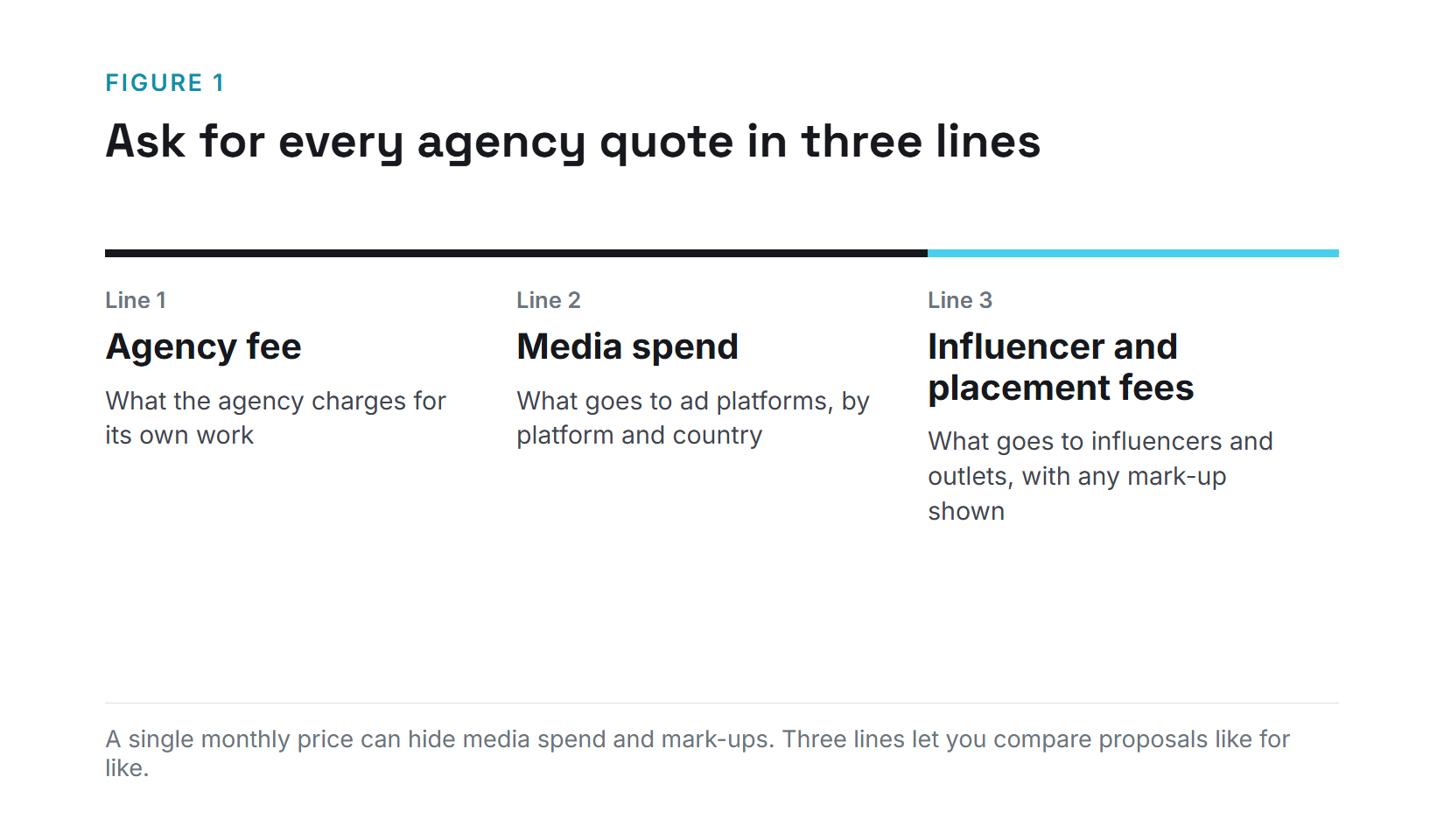
You can then compare proposals line by line. Leave out the agencies that don't split their quote.
6. Judge Results by First Deposits in Your CRM
An agency that works mainly with token projects may report on community growth, wallet sign-ups, and trading volume. A licensed firm needs three numbers for each traffic source:
- Registrations: People who signed up.
- KYC passes: People who passed your identity check.
- First deposits: People who put money into their account.
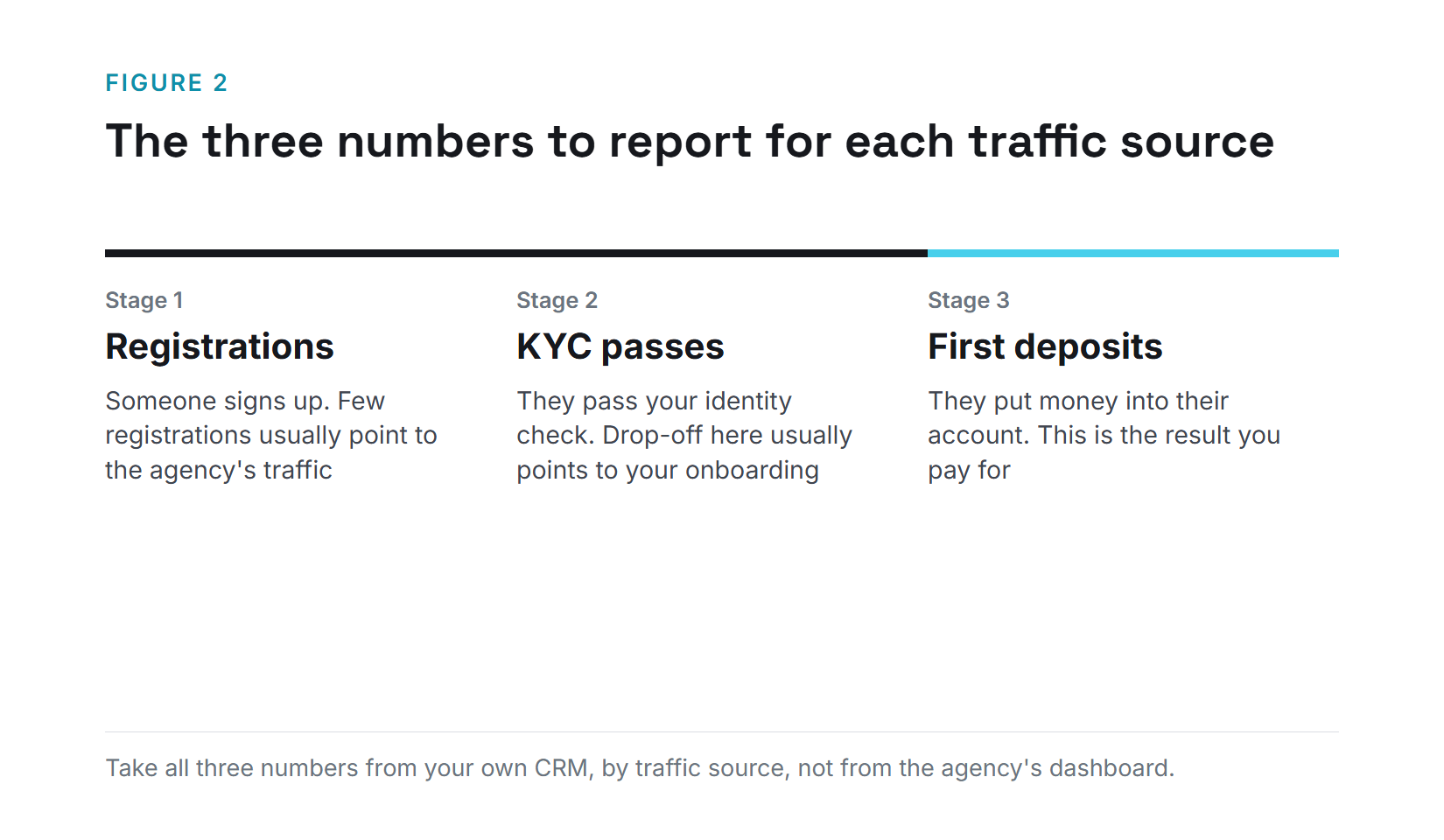
These three numbers show where people drop out. Some of the registrations just point to the agency's traffic. And many registrations with few KYC passes usually point to your own onboarding, though poor traffic can cause this too.
Write these three numbers into the contract as the required report for paid ads and influencer spend. Add a rule that a first deposit claimed by two sources is counted once.
Our team has worked on broker launches in Southeast Asia, the UAE, and Latin America. Some of them needed tracking and CRM work alongside the media. This is why we suggest you set up first-deposit tracking before a campaign starts.
The Bottom Line on Crypto Marketing Services
A licensed broker or exchange should buy the crypto marketing services that bring trading accounts and leave out the token-launch work. Before you sign a proposal, run these six checks on it:
| Check | What to ask the agency | Where to verify it |
|---|---|---|
| 1. Own ad accounts | Whose name is each crypto approval in? | Your ad account approval history |
| 2. Approved, labelled influencer posts | Who approves each post, and what label does it carry? | Your compliance approval records |
| 3. Labelled paid articles | Which coverage is earned and which is paid? | Each live article and the invoice |
| 4. Ad network test | How is each click tagged, and when does the test end? | First deposits by source in your CRM |
| 5. Three-line quote | What are the agency fee, media spend, and influencer and placement fees? | The agency's invoices |
| 6. First-deposit reporting | Will you report registrations, KYC passes, and first deposits? | Your CRM report by source |
Sign a first term with a review date. Make sure the contract says your firm keeps the ad accounts, tracking, and approved ads when it ends. Clickeon is a crypto marketing agency, and our proposals should pass the same six checks.
Send us your current proposals and the countries you are licensed in. We will go through them with you line by line.
Scoping crypto marketing services?
Book a meeting with our team to get a clear view of what your launch or growth phase needs, and what it should cost.
Book a meeting →Frequently Asked Questions About Crypto Marketing Services
What are crypto marketing services?
Crypto marketing services cover the work an agency does to bring customers to your crypto business. It consists of SEO, content, paid ads, influencer posts, PR, and community management. Some packages also include token-launch work such as airdrops and listings, which a licensed broker or exchange does not need.
How much do crypto marketing services cost?
The cost is the sum of three lines: the agency fee, media spend, and influencer and placement fees. One agency, RGray, estimates that most crypto projects spend $3,000 to $50,000 a month.
Can a licensed crypto firm advertise on Google?
Yes, in locations Google has approved, including the UK, the EU and the UAE. For instance, in the UK, the advertiser must be registered with the FCA. In the EU, it must be authorised as a crypto-asset service provider under MiCA. In both cases, Google must also certify the advertiser.
Can a licensed crypto firm advertise on LinkedIn?
Yes, but with limits. LinkedIn requires prior authorisation for crypto exchange and wallet advertisers. The ads may target only seven countries, including the UK and the US. They must target finance professionals and may not target consumers.
What are the red flags when hiring a crypto marketing agency?
Four red flags match the checks in this guide:
- Rented accounts: Ad accounts sold as "already approved", without any named crypto approval.
- Reach pricing: Influencers priced by reach, without any approval step.
- Guaranteed coverage: Named outlets promised as coverage, without the paid label.
- One price: A monthly quote the agency will not split into three lines, as explained above.
When should a licensed firm not hire a crypto marketing agency?
Do not hire an agency for a package that is mostly token-launch work, such as quests, airdrops, and listings. Instead, hire for the services a licensed firm uses. These include crypto SEO, content, and community management.